
Today is Wednesday, August 30,2023. We docked early in the morning at the port in Souda, Crete. Almost all who elected to go on an off-shore excursion in Chania appeared to have chosen the same tour as John and I. We were divided into smaller groups of about 21 each, with one bus and one tour guide per group. We boarded the tour bus and traveled about 15 minutes to Chania,Crete. In Chania, we continued our excursion as a guided walking tour. I am amazed so far on this trip just how well educated, knowledgeable, and linguistically competent our guides have been!
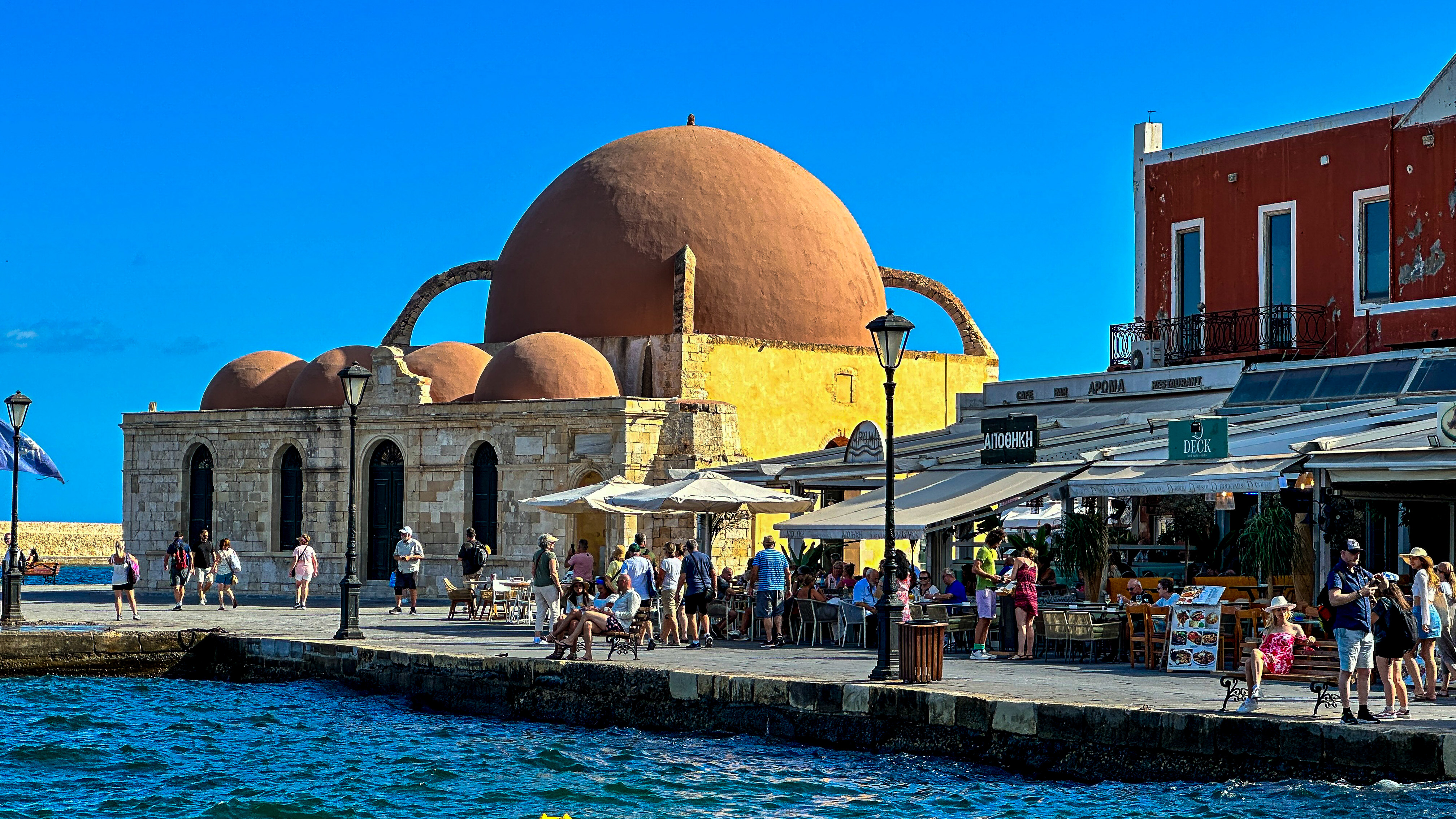
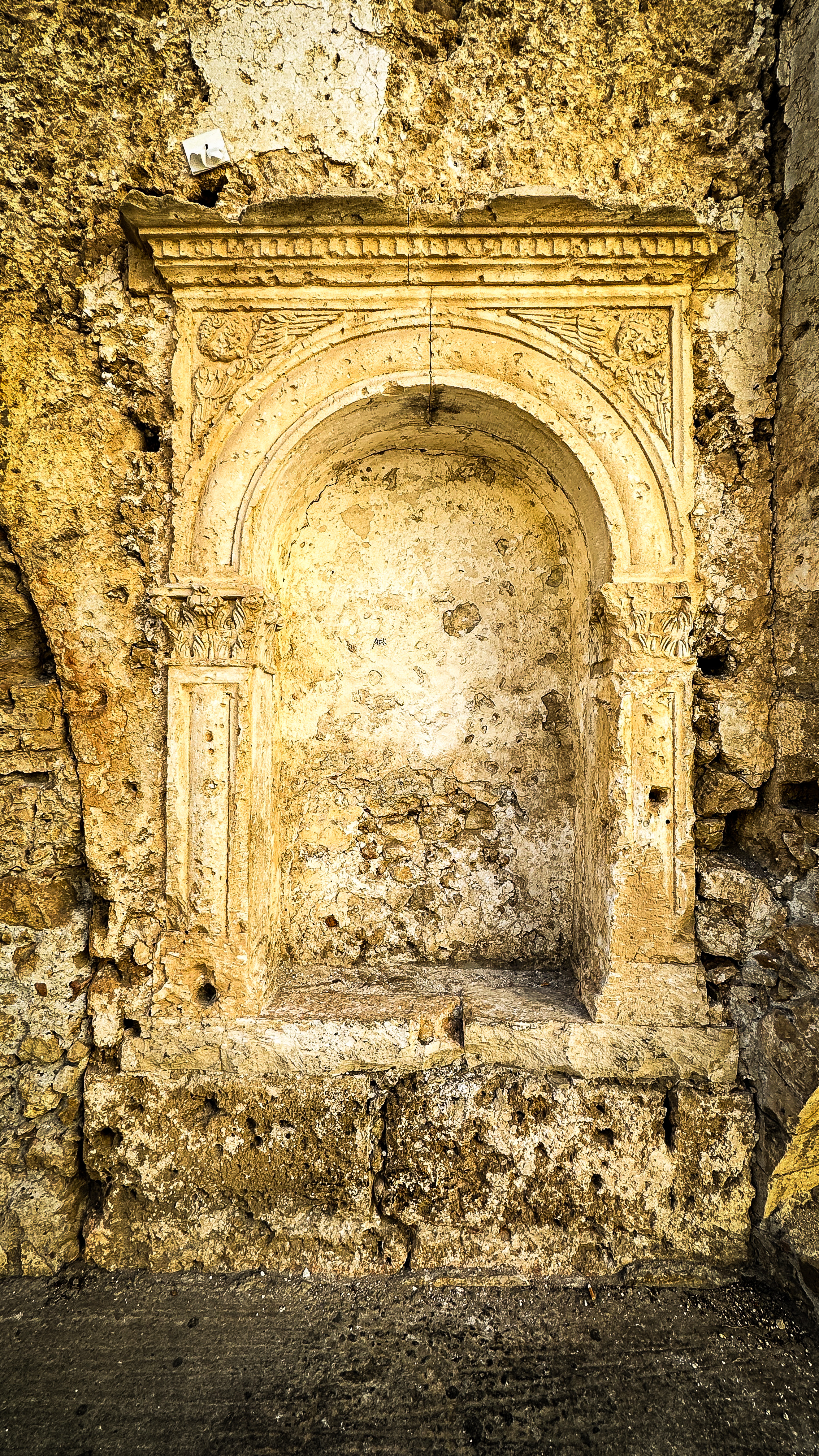
Crete is a long island, the fifth largest in Europe, but it is relatively narrow. It is an important and historically contested island largely because of its hugely desirable position at the midpoint among Europe, Asia, and Africa. Chania is an important city in Crete because of its historical significance and location on the Aegean Sea. The story of Chania is one that is characterized by discussions about the Lafka Ori (aka White Mountains due to the light-colored limestone component and because of the snow coverage in winter), the kri kri (iconic mountain goat), gods, mythology, Romans, leather, bronze, copper, tin, the Bronze Age, the Renaissance, the Venetians, the Ottoman Empire, the Muslims, the Christians, Byzantium, Constantinople, the Apostle Paul, religious martyrs, the Bishop Titus (considered by the Greeks to also be an apostle), ….. The story begins in the era before Christ and continues to present-day, thus there are vestiges (ruins) of ancient civilization that we saw/talked about today on our walking tour. We saw/heard about bastions and wall segments that were built for strategic and defensive purposes, recently excavated ruins of what is thought to have been a huge palatial complex (think Topkapi in Istanbul), historic fountains, oppression, coercion, violence, Christian monastery that was turned into a mosque at one point, a mosque that is no longer operational,….
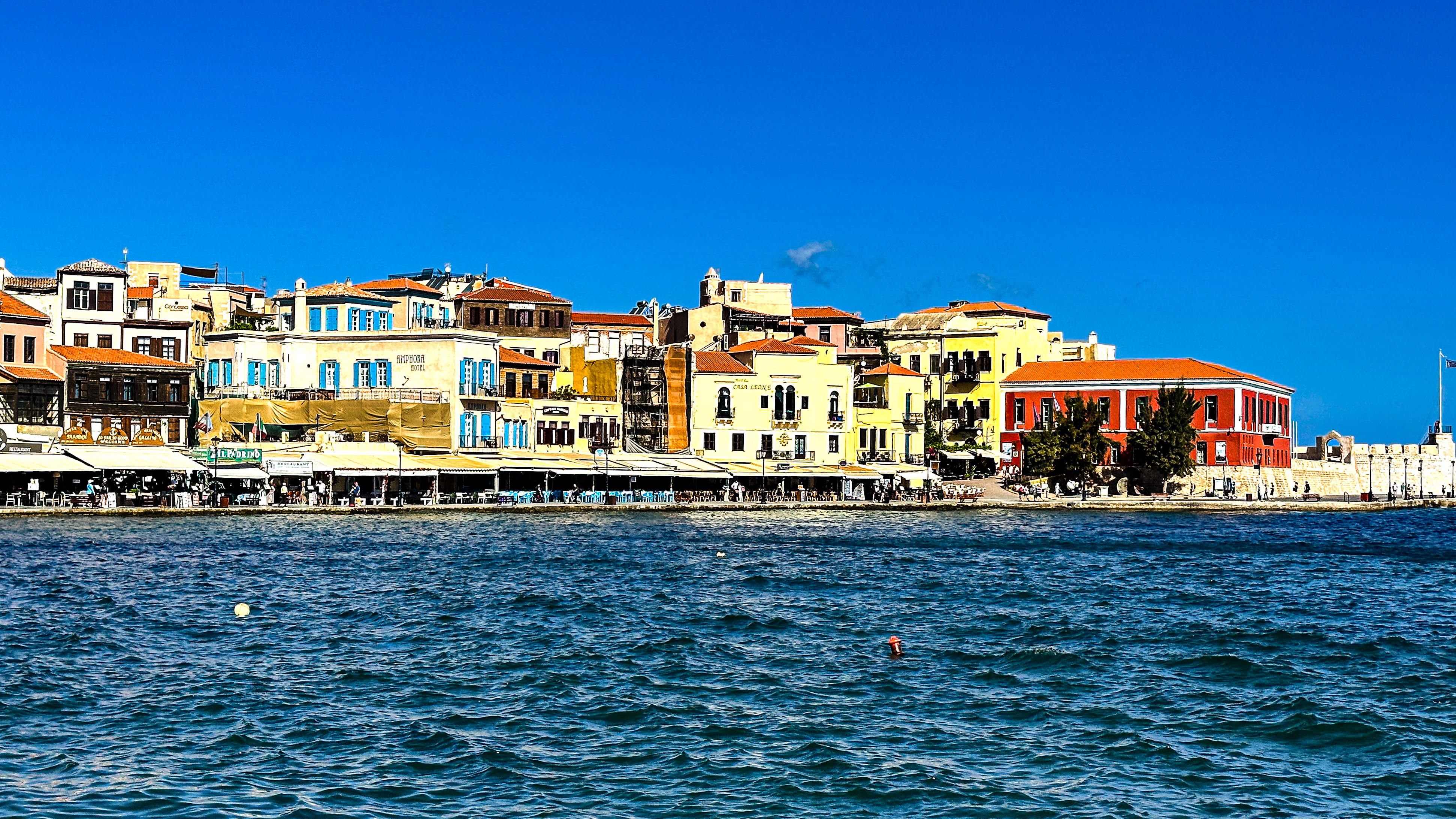
We saw one cat that was perhaps astray. There were beautiful flowers (hibiscus, bougainvillae), vines, and a gorgeous tree, called a jacaranda tree, with beautiful purple blossoms. The architecture shows remnants of Venetian times, although there is an old Hamam (public bathhouse), monastery, mosque, a Catholic Church…. The streets are lined with shops, cafes, and restaurants. Cars and trucks are not permitted on these streets after 10 A.M. but they are allowed earlier than that so that supplies could be delivered to the restaurateurs and other shop operators. We began our walking tour while deliveries were accepted, which required all of us walkers to continuously be on guard while attempting to move along as an intact group and to pay attention to the narration of our tour guide. By 12:30, when the group reconvened to return to the ship, there were no more cars/trucks in town, but even more people crowded the central plaza and narrow shop-lined streets.
We saw wild life today, beyond the stray animals I’ve cited to date. We saw a musician in the main plaza by the seaport, and as he played, a man and women danced what I think as a Greek dance. We also saw schools of teensy fish close to the surface of the water by the seashore. Sadly, these fishes rarely have the opportunity to grow in size because…they are readily scooped up by fisher people and locally eaten. They’re sardines!
Our tour guide explained that Crete’s major product is the olive! In fact, Crete boasts the oldest living olive tree in the world. It is estimated to be about 4,000 years old, and it still produces olives! These olives from this tree are highly prized, and their purchase price reflects that! (We did not have an opportunity to see this tree this time). Olive oil and olives abound, and the Cretans themselves consume “a lot” of olive oil. Other products that are grown in Crete include small, tasty varieties of bananas, all sorts of vegetables, grapes, even grapes whose byproduct is the Cretan raki (wine-like from what is left over from the grapes after they are used for wine), legumes (barley), …. Our tour guide explained that because of the moderate climate and fertile soil in Crete, there is no fruit that cannot grow in Crete. Honey, including thyme honey, is produced in Crete. She explained that when one reads about the Mediterranean diet, one is referring to the diet of Crete.
The ship’s cruise director told us that there are 10 pink beaches in the world and that two of these are in Crete! We could not travel to see them on this journey because they are about a two-hour drive one way from the ship. The ship was leaving port for its next destination before we could return from such a visit. Next time we meet, Dear Crete!
When we returned to the ship, I strolled the third-deck (Promenade Deck) to relish the beautiful weather (hot, sunny, some ocean breeze), and beautiful views from port, especially the sapphire-colored sea. I saw something that looked like brown leaves in the water by the still-docked ship. Except…There were no trees anywhere nearby. Someone on deck declared that they were natural sea sponges. I believed her until…someone else was pretty sure they were jelly fish! They were round-ish in shape, plentiful in spots, and they looked like fried eggs, sunny side up. Unless… they turned onto their side, in which there appeared to be textured something that made them look like a sort of whoopie pie. They were brownish-tan in color. The deck walker who argued these were jelly fish produced a video clip on her phone that showed the brown jelly fish that is harmless to humans and is plentiful in the Cretan waters. Sure enough, the video images matched our observations! And… imagine looking at these critters from a third- or fourth-story window. That was our vantage point! That water must have been pretty clear for us to be able to see these jellies as readily as we did!
Tonight is Holland America’s Orange Night, which is when people wear orange and participate in a great all-night party, if they will, to celebrate Holland America’s official color (It is Holland’s national color). John and I wore orange, headed to a nice restaurant on board for dinner, and attended the subsequent show. Orange festivities begin at 9:30 P.M. We will maybe catch the party the next time it occurs (once per segment of a cruise), not tonight. Tomorrow is an all-day excursion with lots of walking and leaving the ship bright and early.
For now, good-bye, Crete. Tomorrow morning, we dock in Katokolon, Greece, where we engage in an onshore excursion to Olympia!

 Our Travels