
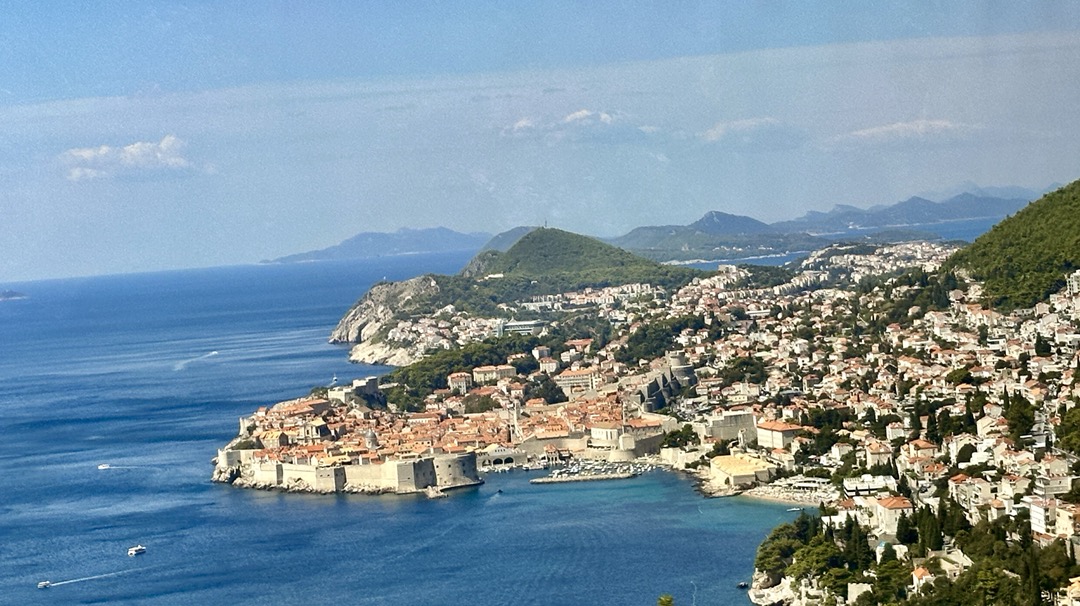
Today is Monday, September 4, 2023. It is not Labor Day where we are. We are visiting Dubrovnik, Croatia, in Europe. I was surprised to see the mountains, blue Adriatic water, rocks islands, and wooded green islands as we prepared to dock.
We began our adventure early in the morning, I.e., 8:45. We had a Dubrovnik and Countryside tour through Holland America. We left the harbor by bus with a tour guide, followed by a guided walking tour, free time, another bus segment, lunch, and a guided bus segment back to the ship. All-aboard was 5:30, and we returned in plenty of time. That’s important to know and respect because the ship will leave latecomers behind (unless one took a Holland America Tour). So, for example, two young women did not arrive to port until 6:00 P.M.-ish today, and the ship left them behind.
Starting with our overall impression of Dubrovnik: Its beauty is absolutely STUNNING! Words and photos do not do it justice! The beautiful sunny, warm climate renders the city even more spectacular, with its light-colored limestone buildings, red-orange tile roofs, dense forested green areas, blue skies, beautifully clear blue Adriatic water, cypress trees, rocky islands, and limestone mountains!
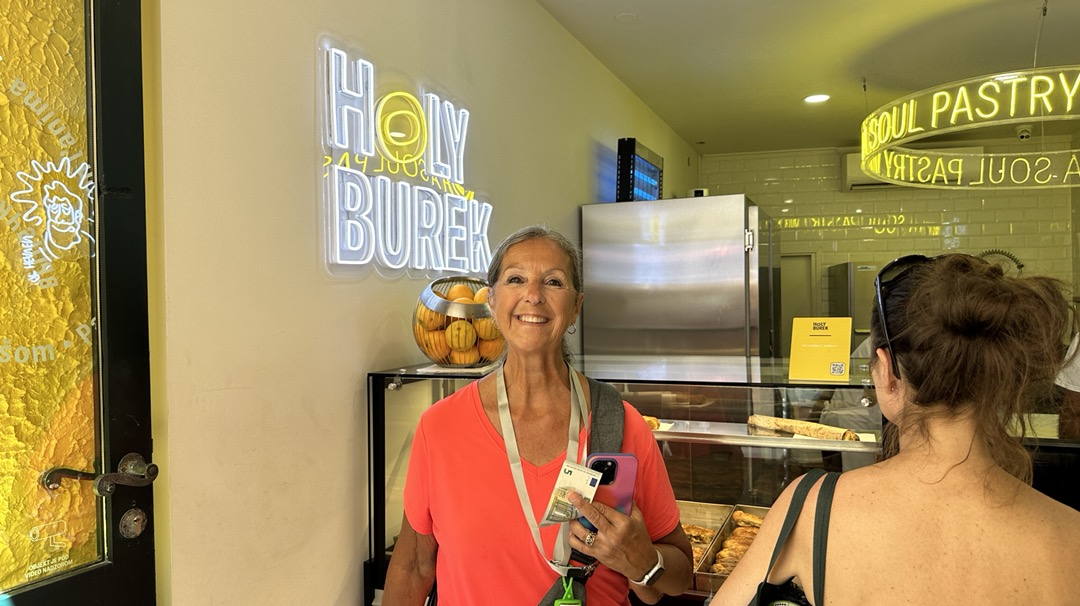
We visited the Old City, a UNESCO site! The city is surrounded by an incredibly intact, well preserved, original limestone wall. It surrounds government buildings; the Customs House; the Onofrio Fountain; a smaller matching fountain; the Church of St.Blaise (Patron Saint of Dubrovnik); Monastery of beloved St. Francis (of Assisi, but who travelled via boat three times to Dubrovnik); monastery of St. Dominic; a Stradum (Main street that is pedestrian only, with large worn-to-a-sheen stone pavement); very narrow walkways that somehow accommodate charming restaurants (with outdoor seating), gelato stands (among the best I’ve tasted! I had Dubrovnik Wild Orange, for example); and Burek shops (burek is a filled long cylindrical rolled “sandwich”, filled with cheese, veal, or cheese and spinach—served warm. John and I shared a spinach and cheese burek based on another customer’s recommendation. It.was.outstanding!); lots of specialty shops, cafes, and restaurants lining the Stradum; and a farmer’s market in the piazza itself. There is an old statue from which announcements to the Locals were made. I took the opportunity to rub the shiny nose of a sculpted medieval priest, noble, and playwright (Marin Drzic) whose favorite topic was a critique of local political leaders (/this was not appreciated by government leaders). Legend has it that rubbing the nose of this sculpture would make one’s wish come true. Needless to say, the nose of this metal sculpture has been rubbed gold!
We drove about 45 minutes along the mountainside, up, up, up, up…until we arrived at a restaurant (Konoba Vinica) where we were served locally produced cherry liqueur and raki, white or red table wine, and a traditional Croatian meal composed of bread, garbanzo bean soup, green salad, roasted potatoes, braised meat (we do not know what animal it had been), and homemade apple strudel. Maybe the main dish was pasticada? No menu was provided, no information given, and no one asked. The seating was outdoor, in a residential-looking setting, with some tables located almost at the same level as a fast-flowing, phenomenally clear river (“very clean water…you can drink the water,” our guide told us), so that one could dip one’s feet in the cold water to cool off while dining on a hot summer day. The drive to the restaurant took us WAAAAYYYY up on a very narrow road toward a mountain top (there was a guard rail about a foot high!), and the views of the Old City, the forests, Dubrovnik in general, the forests, the islands, the sky, and the sea were incredibly breathtaking! Because of the narrow road, I believe, we were unable to stop for a photo op, and it was impossible to capture the beauty from inside the moving bus. This was probably the prettiest scenery of its kind that I’ve ever seen!
The ride down from the restaurant seemed to go so quickly compared to the way there….We arrived back to the ship in plenty of time for the all-aboard.
Among the highlights of the narration today, the following are but a few of what I can recall:
—Water polo is the number one sport in Croatia. Soccer is number two.
—Lots of locals have small boats so they can “escape the chaos and the crowds” of tourists who crowd Dubrovnik.
—Parking space is a major concern in Dubrovnik because the city was not built for such traffic/crowds.
—Locals in Dubrovnik always find time and money for coffee.
—The walls surrounding the Old City are the best preserved in Europe.
—Forest fires plague the city in summer.
—Dub in Dubrovsky means oak, and Dubrovsky means oak city.
—1300 to about 1900, Dubrovsky was a city state ruled by nobles until Napoleon destroyed the city state.
—As a city state, there was no army. There were only the city walls for protection, and the people relied on diplomacy.
—Dubrovsky has officially been under UNESCO protection since the 1970s, but the Serbians attacked it in the 1990s, anyway.
—In 1667, an earthquake and tsunami devastated most of what existed before then. Several structures survived: Divine Savior Church, the Onofrio Fountain, St. Blaise Cathedral….
—Venice and the Ottomans were trade rivals for Dubrovnik.
—Sea salt was called “white gold” for trade in Dubrovnik.
—Onofrio, from Italy, was charged with figuring out how to bring potable life-saving water to Dubrovnik. The Onofrio Fountain and its smaller duplicate still flow, and the water is drinkable.
—St. Blaise Cathedral survived the earthquake but succumbed to a fire four years later. Had to be rebuilt.
—A statue on the Stradum had three steps and a top area from which major announcements were made to the Locals during the Republic: step one was for minor news; the top of the statue was for extremely major news. The saddest news delivered to the Locals from the very top was in 1808, announcing the abolition of the Croatian republic by Napoleon Bonaparte.
—St. Dominic Monastery houses some major artwork from the Dubrovnik art school to the Byzantine gothic style and into the Renaissance. Even Mary Magdalen, rarely depicted in Christian art, is in two paintings we saw today.
—During the Croatian Republic, negotiation and collective decision-making (by the nobility in power) were critical. Unilateral decision-making, even if proven effective in the long run, was subject to punishment.
—Cypress trees are plentiful in Dubrovnik. They are elastic, and they were used for shipbuilding, madt-building, and in construction of beams that could bend with earthquakes and strong winds that characterize this region.
—Wild boars are plentiful in the thick forests. They come out at night, and a pack of six can devour an entire vineyard.
—Kiwi and pomegranates grow here. Pomegranates are effective natural blood thinners, with no negative side effects. Grapes that produce Malvasia wine grow here. Olives and olive oil are grown/produced here.
—Croatian sea water is among the clearest in Europe.
—National tradition of producing silk. Silk is used in traditional costumes. Often different patterns reveal whether the woman wearing the costume is a widow, single woman, married,… so that people know at a glance how to approach her.
—The tall mountains protect the city from destructive bora winds.
—The tallest peak is 1,234 meters.
—Families in Dubrovnik/Croatia typically produce their own olive oil and wine, even vegetables,… That way, they do not depend on malls, markets, preservatives….They exchange seeds and preserve for later use.
—Croatia has 1,244 islands, 66 inhabited.
—The Island of Lokrum is supposedly cursed (legend). “A good place to go for a day visit, maybe, but not for over night,” says our tour guide.
Tomorrow morning, we dock in Sarande, Albania.


 Our Travels