
Today is Sunday, September 10, 2023. This is the day our cruise ship does Tuscany, Italy! Tuscany is where I, Nonno, Nonna, my Nonno and Nonna, and most, if not all, of my ancestors from what I have been able to tell thus far were born. This means that this area is also in your blood lines, and in your children’s. This is a very special place for me!
We docked in the Port of Livorno. Bright and early, we boarded a tour bus to Portovenere and the Cinque Terre. Portovenere and the Cinque Terre are actually in the Ligurian region of Italy, slightly northwest of Tuscany. But to get there! we drove through the countrysides that were close to Pisa and Florence (capital city of Tuscany). Lucca (my native province) is a short distance from Pisa. Thus, all of this terrain was “familiar” to me, a truly awesome experience! We saw the Tower and Baptistry of Pisa as we drove past, from a distance.
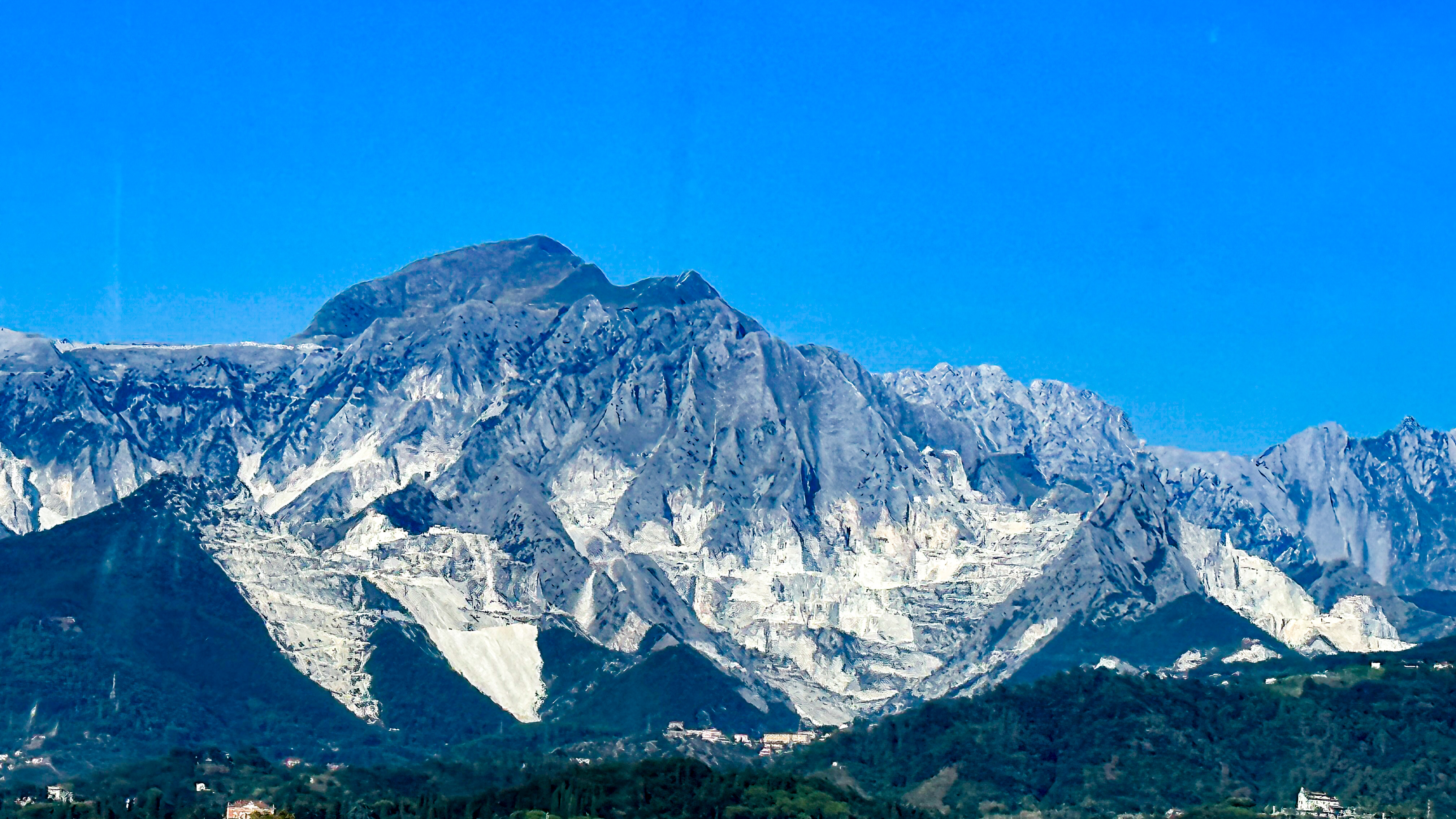
We passed the Pisan Mountains (the Appenines around Pisa), and saw the spectacular Apuan Alps towering behind them, with their blue-white hue because this is where the beautiful white marble of Carrara is mined! My grandmother and great-grandparents on nonno’s side were either born or lived there for some time, for example. Even Andrea Bocelli is from the Pisa area, Puccini, who wrote La Boheme, Madame Butterfly (operas) is from Lucca. Collodi, the author of Pinocchio, lived in Lucca. And let’s not even begin with the big names that came from Florence!
We drove past the River Arno. And we ended up in Portovenere in Liguria, Italy. The capital city of Liguria is nearby Genoa. These are extremely important and coveted seaports for trade. The Italian Navy Seals train in Portovenere. Italian and NATO Military ships and even a destroyer were docked in the Ligurian Sea at Portovenere today. Needless to say, this region was heavily bombed in WW II. The subterranean bomb shelters are still there, as evidenced by their entryways!
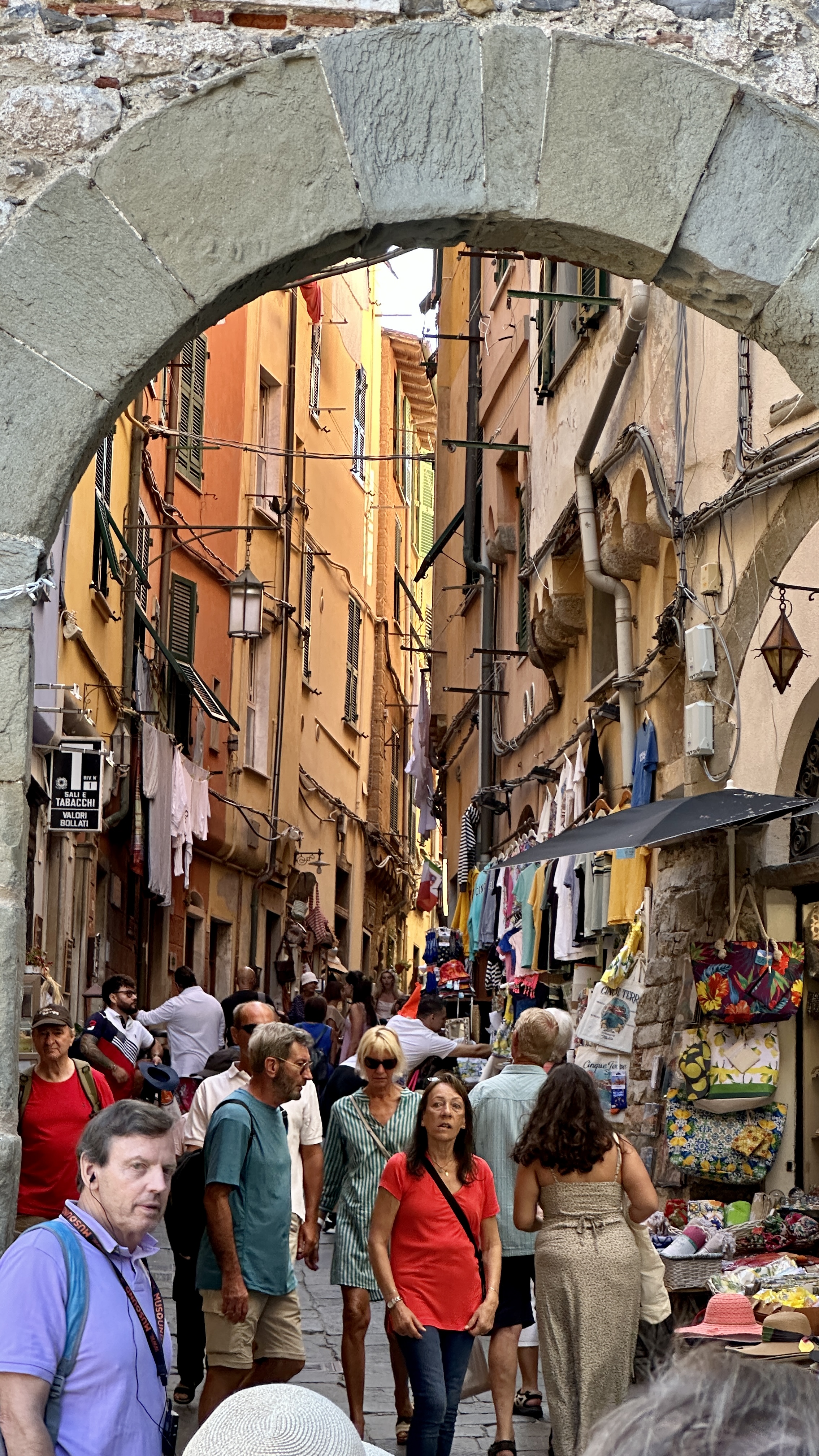
The sea and the mountains leave limited available living space in Portovenere, so one can live in a very narrow, tall flat with five or six stories, with only one room per story/floor! Some wider buildings might have two rooms per story, and some flats might go horizontally instead of vertically, depending on the layout of the land. Furniture cannot be moved into or out of the vertical buildings, in particular. It has to go through a window. If a person dies in such a building, the coffin cannot pass through anything except a window. By building these residences vertically, narrowly, attached one to the next, a wall surrounding the city was formed, which was intended to protect the port and the city from pirates, for example. We saw a charming St. Peter’s Church, perched on a rocky shoal, that is used only for weddings. People come from around the world to marry at this Church.
This whole Portovenere and Cinque Terre region are known for anchovies, mussels, capers, black olives and the olive oil made from them, grapes that produce a coveted white wine, pine nuts, and basil. It is known for PESTO! We sampled Pesto and white wine as part of our tour. It is also known for the famous poets who drew inspiration from the region.
We boarded an open-air ferry that would bring us from Portovenere to the most distant village of Cinque Terre. This whole area is known as the Italian Riviera, it should be noted. In fact, our Guide told us that Steven Spielberg pulled up in a yacht the day before, and Giorgio Armani’s is sometimes docked there. The Ligurian Sea today was unusually calm, and the clarity and color of the water are incredible! The color is in places clear aquamarine, and in others, a beautiful clear turquoise. There are rocks, particularly on shore, but people seem to enter the water wherever they please and sun bathe atop the rocks or on “sandy” (gravelly”) beaches.
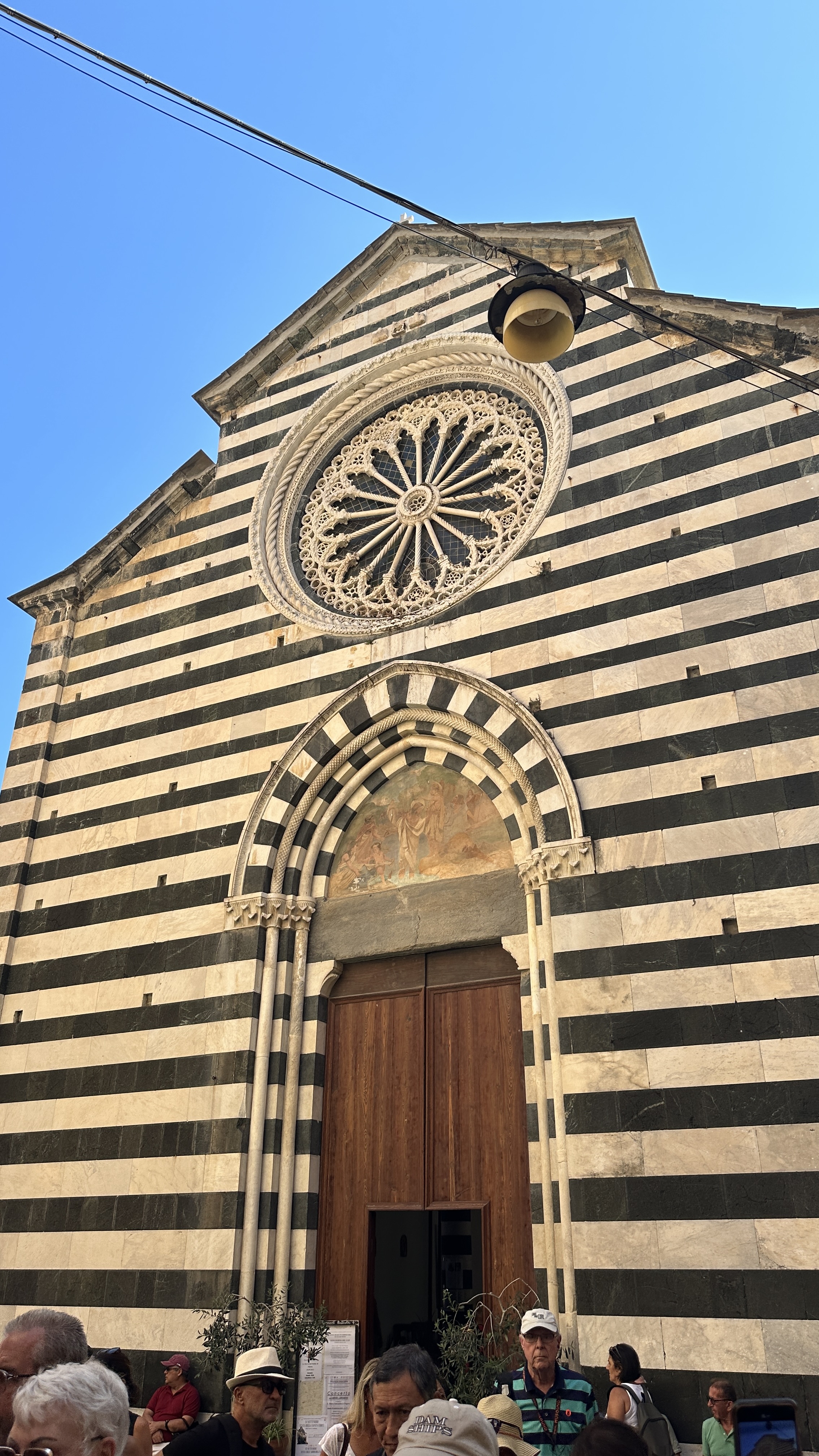
Cinque Terre means five villages. Five distinct villages span along six kilometers of coastline. The Cinque Terre and the entire coast line developed entirely below sea level 200 million years ago. The color and composition of the rocky coastline differs based on how much iron, the fossilized sea shells, and so on that formed it long ago. The Cinque Terre is a designated UNESCO World Heritage Site because of its uniqueness, so no more construction can take place to alter it in any way. All the villages are distinct, but they are all lumped under a collective title of Cinque Terre because they are all wine producers and because they are fed by one river. One can hike from one village to the next, or one can take a train or ferry of appropriate size. One road has been built to bring supplies to th3 villages. The villagers terraced the steep hillsides by hand to grow olive trees or basil, or grapes. However, many villagers are moving away from agriculture (it is hard manual work) in favor of tourism (easier on them). Nevertheless, terracing is not eliminated altogether because terracing protects the soil and rocky hillside. Each village has its own Church.
From Portovenere, one first greets Rio Maggiore, then Manarola, followed by the third village, Corniglia, which is built 350 feet above sea level (if one takes a train to this village, one must then climb 400 steps to get to town, and only smaller ferries can access this village), the fourth village is Vernanza, and the fifth is Monterosso.
John and I shared a traditional Ligurian meal on Portorosso, and we shared another (the second of this area, the first in Portovenere) artisan gelato (there is a certification one can boast if one qualifies as a bona fide artisanal gelato maker/vendor). The gelato is creamy, tasty, and not disgustingly sweet. It is refreshing on a hot, sunny day.
Finally, we boarded a train in Monterosso, which brought us back to Vernanza, where our tour bus met us on what I think is the only road mid-hill that brings supplies to the Cinque Terre.
Today was a perfect day, and we are sad to leave Italy for now.
Tomorrow, we are in Toulon, France.

 Our Travels