
October 3, 2024–
It had rained overnight, and the ground was wet when we left our B&B in Lezzeno this morning. The rain and/or clouds followed us as we drove about three hours from Lezzeno to our next stop, Bobbio in the Emilia-Romagna region of Italy.. By the time we reached the outskirts of Bobbio, the rain was steadily more than just a drizzle. In addition to the rain, the wind was a bit stronger than it has so far this trip to Italy. The temp was only in the 50s. All together, this was a raw, wet, chilly day! But…it is what it is, and we are grateful for what we have; so, we ventured on to the Relais Sant’Ambrogio, our stay for the next two nights.
The reviews on Bookings.com for this highly-rated Relais (I think a Relais has a restaurant option somehow connected to the hosts of the facility, some spa or pool option, and/or breakfast-included on location) suggested that the road up to the facility was narrow and winding, but that it would be a minor inconvenience relative to the overall quality of the Relais. The reviews were not kidding! We are located in the Ligurian Apennines (mountains), and as we got closer to the Relais, the road became extremely narrow, with some switchbacks, and no guardrails at the edge. Dad says that this is still not as challenging as the Farm in Alto Adige, but the road from the town of Bobbio is twisty and hazardous enough to make us ensure that we whatever we chose to do during daylight, we would be back to the Relais before dark.
Here’s the issue we have with that constraint (and, we recognize that the constraint is self-imposed. Locals don’t obviously have this issue): It turns out that Thursdays are the day of rest for most businesses and restaurants in town. It also happens to be a day of rest for our Relais hosts, which means that there is no breakfast nor dinner option on location if it’s Thursday. Additionally, even though some Bars stay open in town regardless, and even if some restaurants do, the kitchens close for meals between about 3:00 P.M. and 7:30 P.M. By 7:30 P.M., it is beginning to get dark, which means that Dad and I will not be staying in town for dinner. We walked in the chill and rain around the town center looking for somewhere to have dinner, and finally, for lack of other options, we settled for a place with thick pinsa (pizza) slices and a bakery item left over from today’s breakfast time. I did have a macchiato Americano coffee, and although it was hot, I am finding that the Americano descriptor renders the coffee a little stronger than hot mop water. I am drinking hot tea that we can make in our room right now. We have no milk because even those grocery stores closed earlier than we thought. We could not purchase milk to bring with us. Nevertheless, I might just have to become a tea drinker throughout this trip as a rule of thumb. The regular Italian coffee tends to be extremely small in size/volume, and to me, it tastes so very strong! You win some and lose some: With regards to a regional dinner today, we did not win. Tomorrow will hopefully be a better day. We look forward to breakfast at our Relais in the morning, and hopefully, we will enjoy a good dinner with regional favorites before kitchens close in the afternoon or perhaps even at the Hosts’ restaurant, perhaps on-site, which reviews say is very, very good.
Speaking of regional food, I love polenta and anything with chestnuts. Corn and chestnuts are local in Veneto, Emilia-Romagna, Piemonte, and Lombardia. I got a small piece of roasted polenta during our food tasting tour in Venice. Our fantastic hosts in Lombardy made us a polenta dish because they knew I had not yet found polenta in the restaurants. Those same hosts roasted chestnuts for us, also. But, otherwise, we have not found chestnut dishes in any of the restaurants that we have frequented. And yet…scattered disrespectfully on the ground beneath some chestnut trees in town center of Bobbio were lots of chestnuts! WHY? WHY are people not serving these yummy foods in local restaurants?!?!?! I’m going to look for some tomorrow, and if I don’t find polenta and/or chestnut dishes, my next big hope is Tuscany. I KNOW they grow and are eaten there—at least, they were when I lived there so long ago! I remember going chestnut gathering with nonna, my Mom.
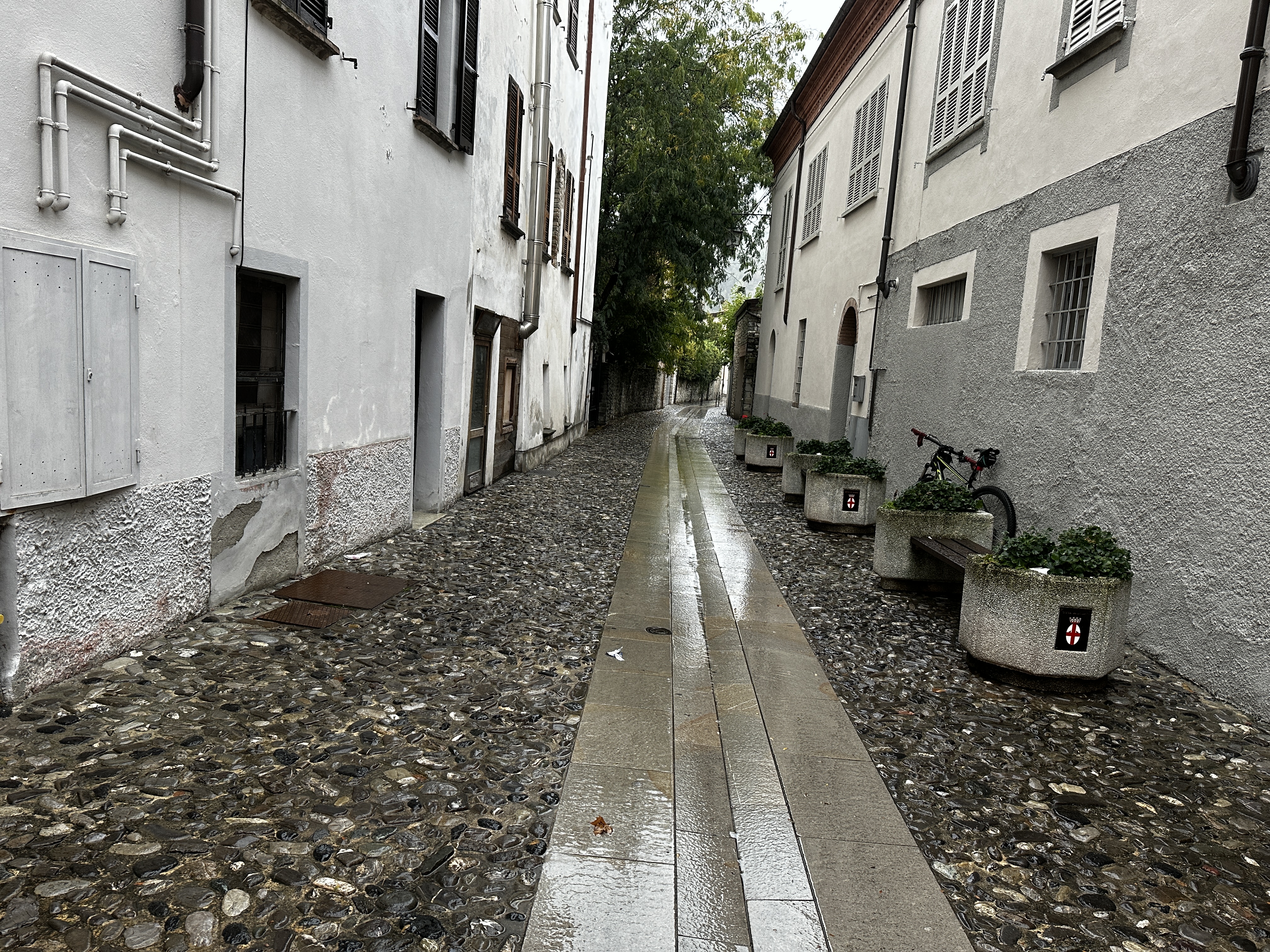
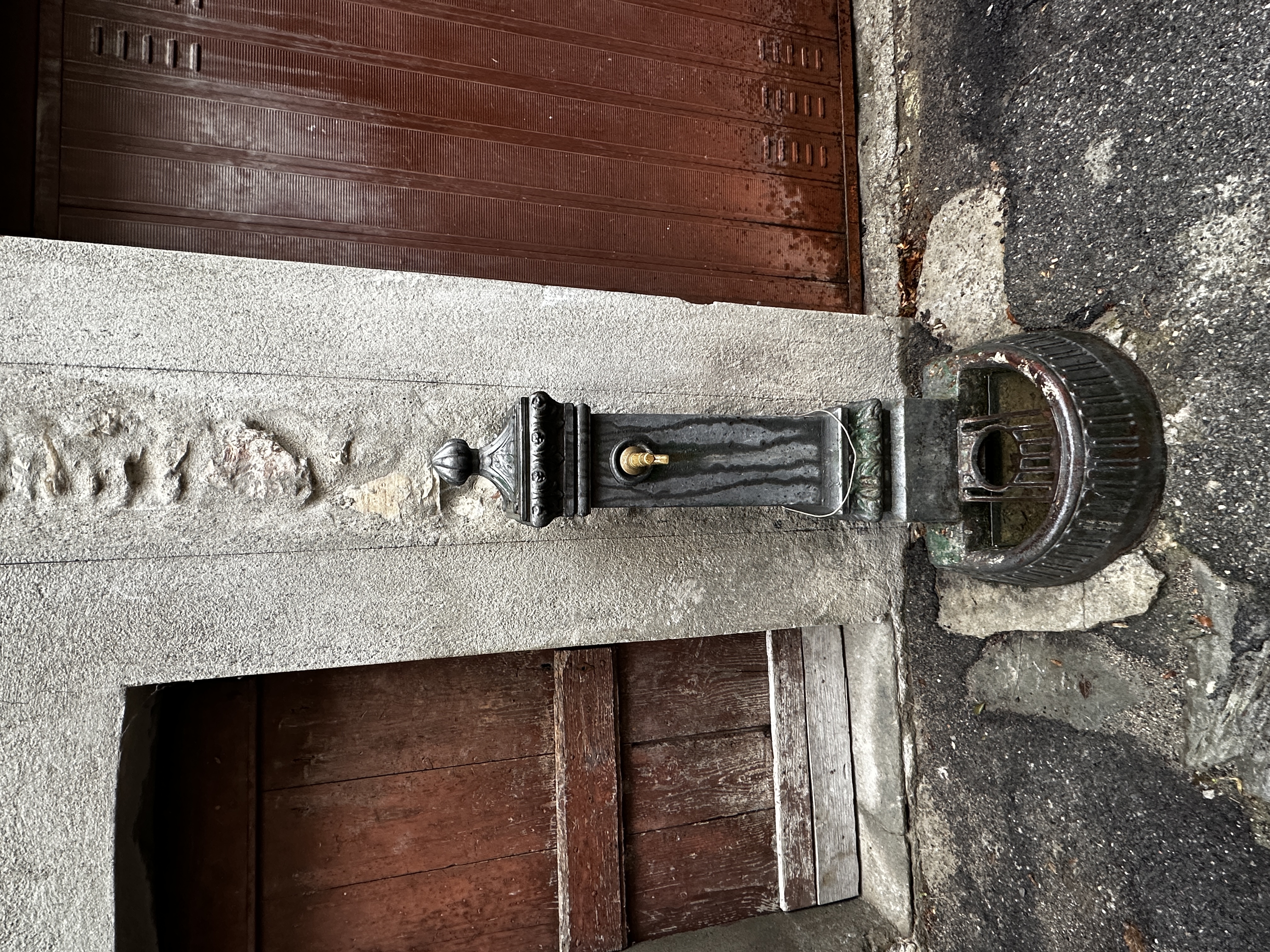
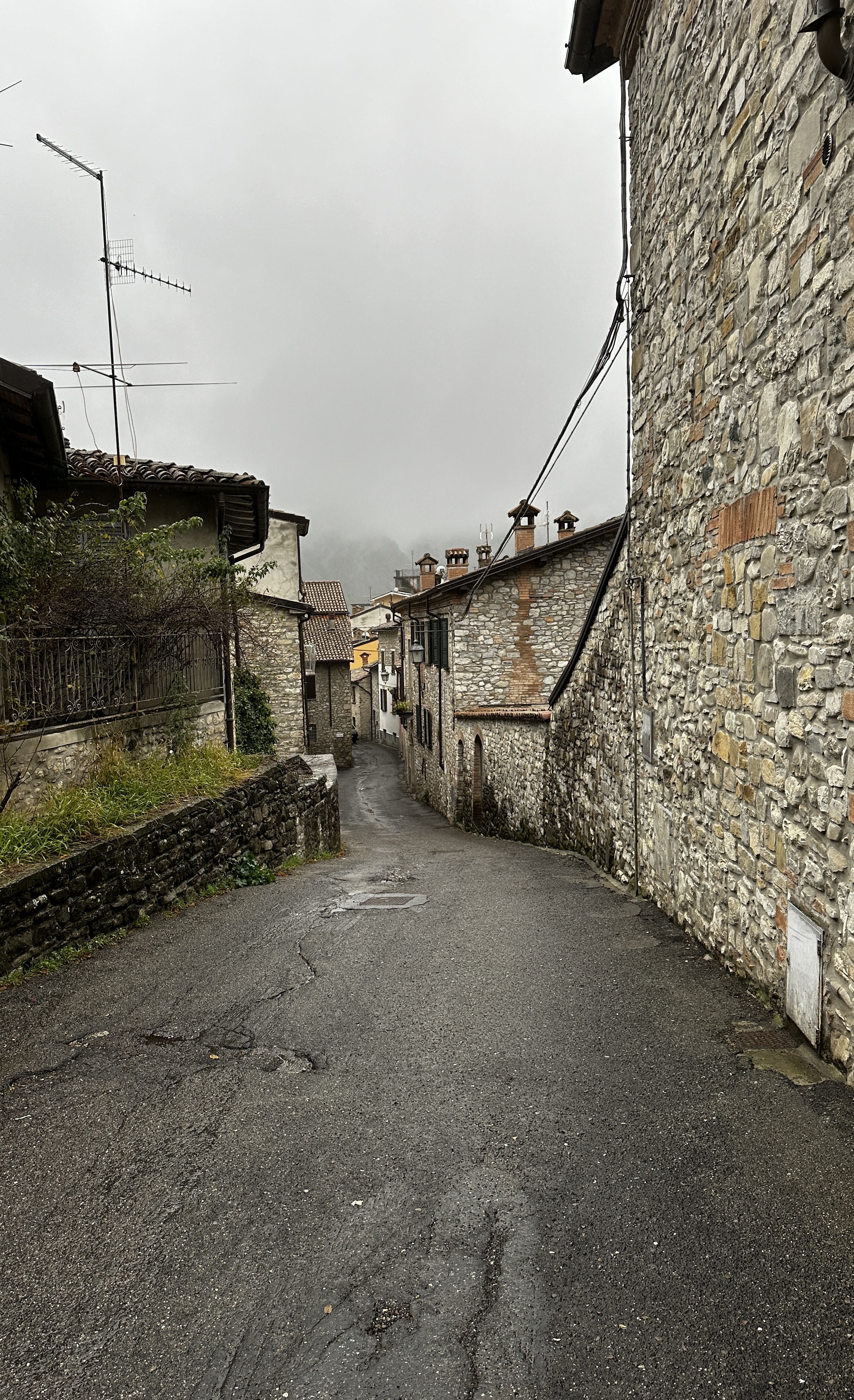
The town center of Bobbio appears to be small and charming. An Irish monk named Colombanus founded it in around 614 AD. He built a monastery in town that was renowned for one of the best libraries and writing rooms at the time. The monastery is still there. We saw the exterior. Tomorrow, we will explore it more. The streets are similar to other towns on hills/mountains that we have visited thus far. There are narrow passageways that one can walk to go from one part of town to another. The residences look old, yes, but charming. The typical fountain is there. Hopefully, the rain will have gone away by the time we head out in the morning, and we can catch this town’s highlights before we move on to Tuscany.
Speaking of Bobbio’s highlights, one cannot miss the Trebbia River that, by its color, appears to flow from the heights of the Apennines around this town, picking up dirt and debris as it sometimes rushes feverishly over different-sized stones and rocks. Connecting two sides of this Valley over the Trebbia River is an iconic old concrete bridge with 11 arches (think Roman times), each arch a different size. The different-sized arches results in a bridge walkway that dips and rises accordingly. It is called Ponto Gobbo (the hunchback bridge) because of its appearance. It is also called Ponte Vecchio (the Old Bridge). And my favorite name for it is Ponte del Diavolo (the Devil’s Bridge). Legend has it that the monk named Columbanus wanted help with building a bridge to connect the lands at both sides of the Trebbia River. The Devil offered to help, claiming that he could build the bridge in one day IF Columbanus would permit the first soul to cross the new bridge to be claimed by the Devil. Columbanis agreed, and the bridge was built. The crafty Columbanus, though, arranged for a dog to be the first to cross the bridge, thereby saving human souls from the Devil’s grasp. According to that legend, the arches are different sizes, the bridge pavement is curved accordingly, because…the Devil had helpers who were all demons, so what else would one expect? I do love that story! Anyway, that bridge might be the same bridge that Leonardo Da Vinci painted when he created the Mona Lisa, according to some research. All sorts of military, saints, nobles, and other people have crossed that bridge since it was built. The first documents that have cited this bridge date back to about 900 A.D. That early bridge did not have as many arches. It “grew” to its present number around 1300 A.D.
Our hosts in Lombardia mentioned Foliage (pronounced foe-ly-ahj) trains/tours that are in great demand during autumn when vine leaves change colors. Evidently, they turn shades of red, orange, yellow, green…, and they are beautiful. There are vineyards around this Relais, too. We could still see them through the mist and fog today. Wines are produced from the grapes of this region. The vines are showing the beginnings of color transformation. The ivy that creeps along the sides of concrete walls, however, are a bit advanced from the vineyard leaves. We spotted different shades of red, green, brown,…. They sure are pretty!
We look forward to exploring the pretty little town of Bobbio tomorrow in a little better weather. It is, after all, listed as “One of the Prettiest Towns in Italy.”


 Our Travels