
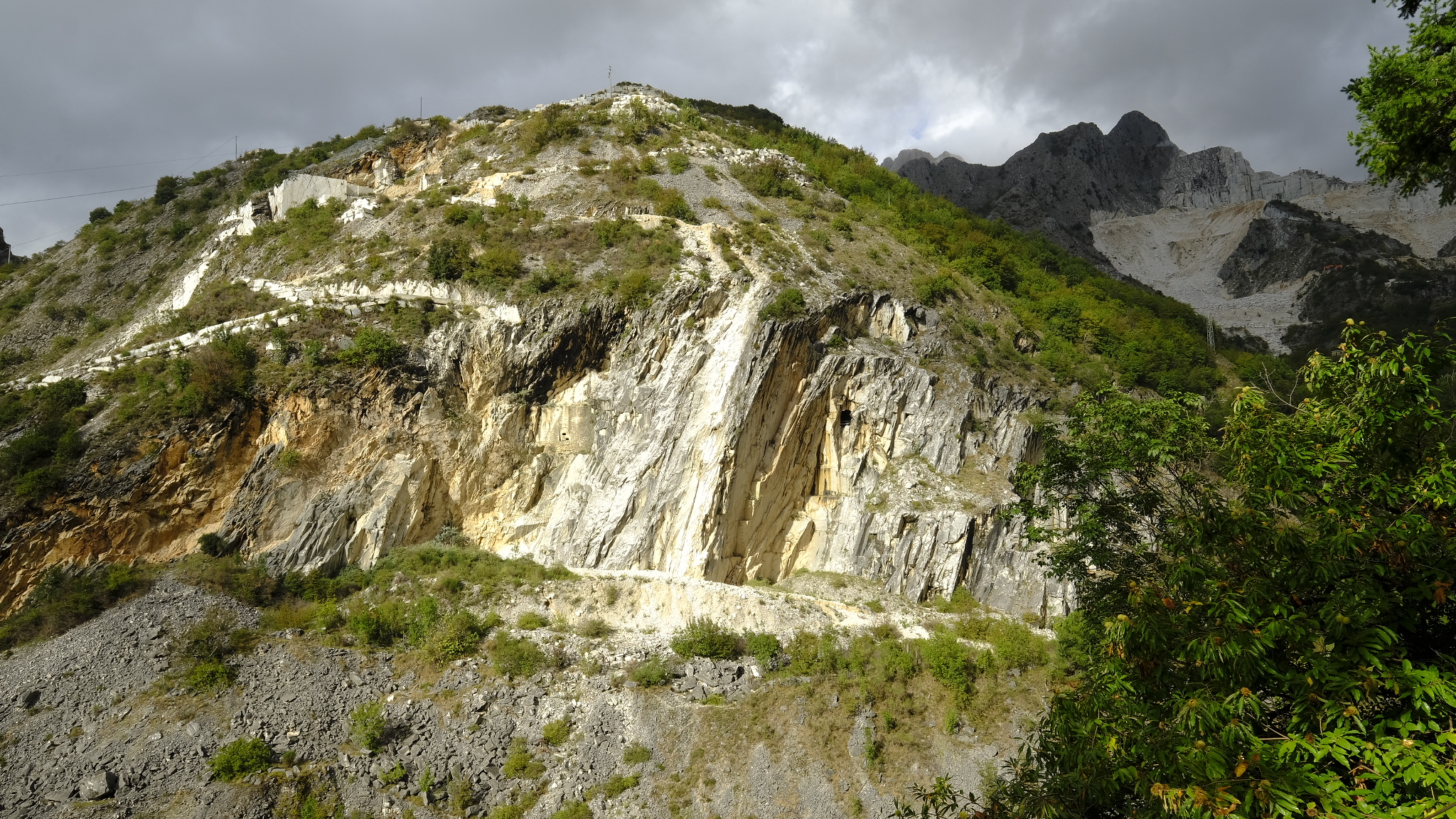
10 October 2024–We are still in Coreglia, and it is still cloudy and sometimes spitty outside. Nevertheless, the scenery/landscape is phenomenal. The Apennines and the Alps are clearly visible outside our unit’s door, and the green vegetation all around is soothing and visually breathtaking! With a collection of mosquito bites and recognition that there were likely more to come, we ventured out to Avenza, Carrara today to try to find some ancestors on nonna Lina’s/my father’s (Angelo Carzoli) maternal side. It should be noted, too, that although our primary purpose these couple of days is to find some ancestral information, we are simultaneously touring and sight-seeing the beautiful countryside/terrain on which these precious people were born/lived/worked/played/and died. Seeing just how far or how near some of these small towns I have found throughout the research I have already conducted, and taking in the terrain that these people had to navigate on a daily basis or if they even thought of traveling has been enlightening to say the least. Although these cities/towns might now have been so far away, I.e., just on the opposite mountain side or top, getting there without cars and paved roads was often probably impossible. Thus, people traveled in search of work, but often they tended to stay in one town for generations. Even if they did relocate, typically they did not go very far away. My cousin Alfredo Carzoli, who lives in Prossedi, has been a great help to me. He has always lived in Italy and is much more cognisant of where our paternal grandparents lived from one place to the next. So, for example, he told me that for some time, the family (not my own, however) lived in Terrarossa. On the map, that is not too far from Carrara nor from La Spezia. Therefore, it is likely that when I learned and mentioned the other day that nonno had been detained in that region because he had traveled without necessary papers, perhaps he had traveled in search of work, yes, but he also might have traveled to visit with his parents and brothers’ families. So, we got to Avenza. We headed immediately to the Church of San Pietro Apostolo. That is where Nonna Lina was baptized, and I had hoped that I would learn about her parents, ancestors, if she had brothers and/or sisters, and so on. I have been able to unearth a lot of information already about my nonna’s line, but it has been a challenge, and I was hoping to fill in some gaping data holes and confirm what I had already found. The Church was closed for a few hours because the priest was at lunch. We returned later on, but the priest was still not there. Luca and another staff member told me that the priest had had a funeral that day so he might or might not be back today. Nevertheless, the Church was open now, and I was able to view it. It was a moving feeling, knowing that nonna Lina had been baptized there and had likely been a parishioner for quite some time until she marrie nonno. I saw the baptismal font where she had likely been baptized. We went to Trugliano Cemetery in Avenza, where we were told by townspeople that people from Avenza were likely buried. Unfortunately, there were very, very few graves/gravestones in the older section from the 1800s. We learned from one of the San Pietro Apostolo church staff people that the cemetery of Trugliano is not the original cemetery where people from Avenza were buried in the 1800s; however, that cemetery no longer exists. In fact, nothing about the people buried there exists because they were likely cremated and any gravestones tossed. I did jot down the parish priest’s phone number, and I hope to contact Don Marino when I return to the U.S. to ask for assistance with data I have been struggling to locate. Meanwhile, we saw Via Gabella where nonna Lina was born (it is almost right across the piazza from the Church). It is now called Via Farini. Just down the road from the Church is Vicolo Limone, also where Nonna Lina lived at one point. While we were in Avenza, which is right there by Carrara, we found and viewed the Ospedale Civile di Carrara where Nonna Lina’s mother, Maria Rosalinda Del Padrone, died at 33 years of age. She would have been in the original hospital, not the more modern one up the hill a little bit. That older section is still functioning at some capacity. I visited the little chapel inside, thinking that perhaps that is where Nonna Lina (a toddler then), her father, and grandparents, perhaps her brothers and/or sisters prayed for Maria Rosalinda’s recovery. I said a silent prayer for them as I visited this Chapel. Finally, Nonna Lina’s father, Pietro Ceccarelli, had been a scalpellino, a marble chiseler. Carrara is known for the marble that is mined and exported from there to the rest of the world. Carrara marble is also the marble that Michelangelo used to sculpt his David. The marble is mined from the Apual Alps bordering Carrara, and it has a beautiful blue-ish vein that runs through the white stone. At the time, I.e., in the 1800s, marble mining was done by hand. It appears as if that was a very dangerous occupation, and there is a road/shrine for “victims of work” at the foot of one of the mountains. There are marble blocks in many places around Carrara, all in various stages of refinishing and preparing for ultimate export/sale. But we drove up one of the mountains that had some active quarries to understand that occupation/terrain a little more. Even the “injured” Alps displayed beautiful stone colors/striations where marble had been extracted. And, yes, how does one even stand up high on a mountainside and work with heavy objects such as huge blocks of stone?!?! The Churches in Carrara surrounding the marble quarries still have old churches and edifies with carvings asking God and the Blessed Mother to help/watch over these marble workers and their families.

 Our Travels