
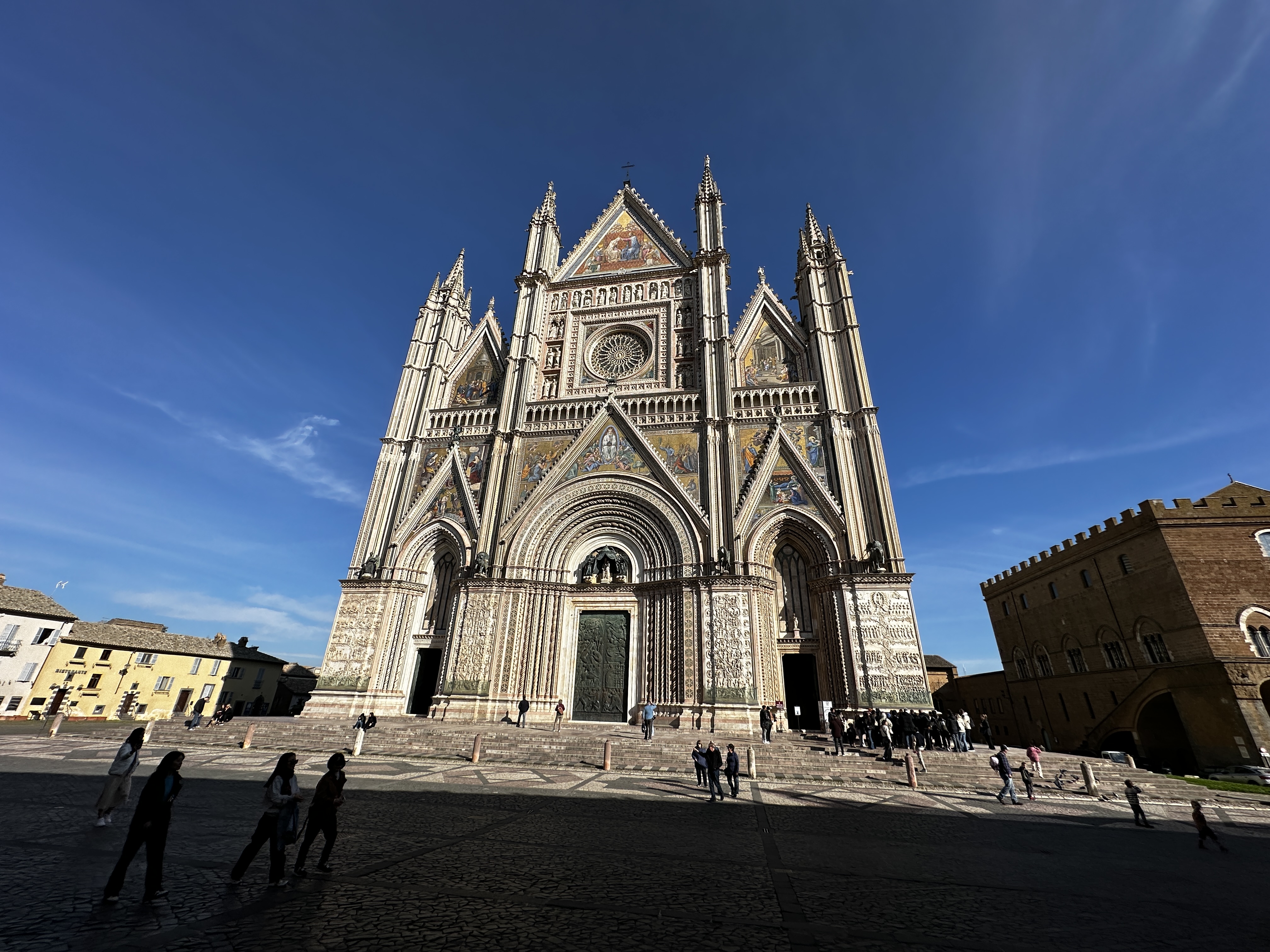
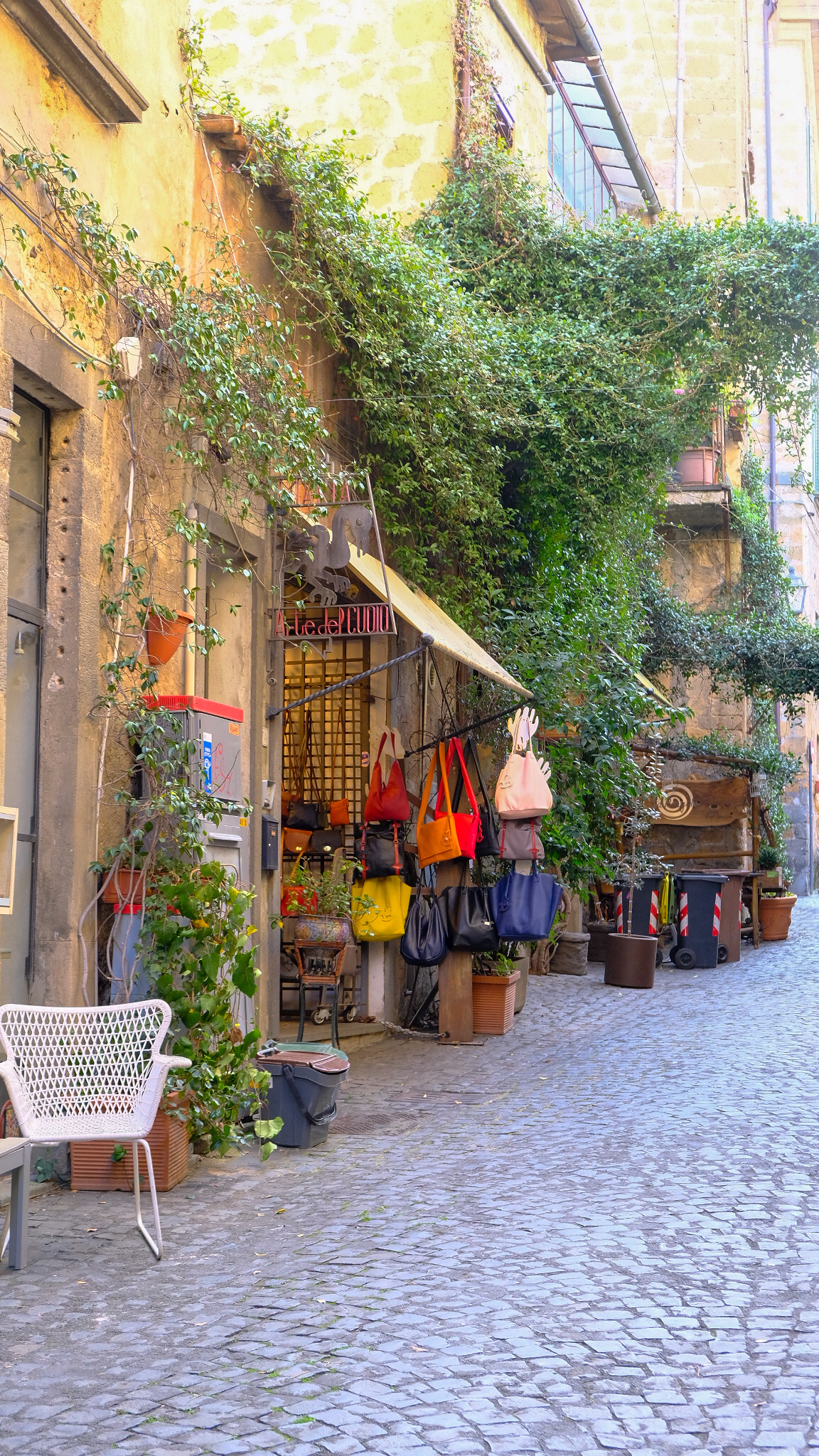
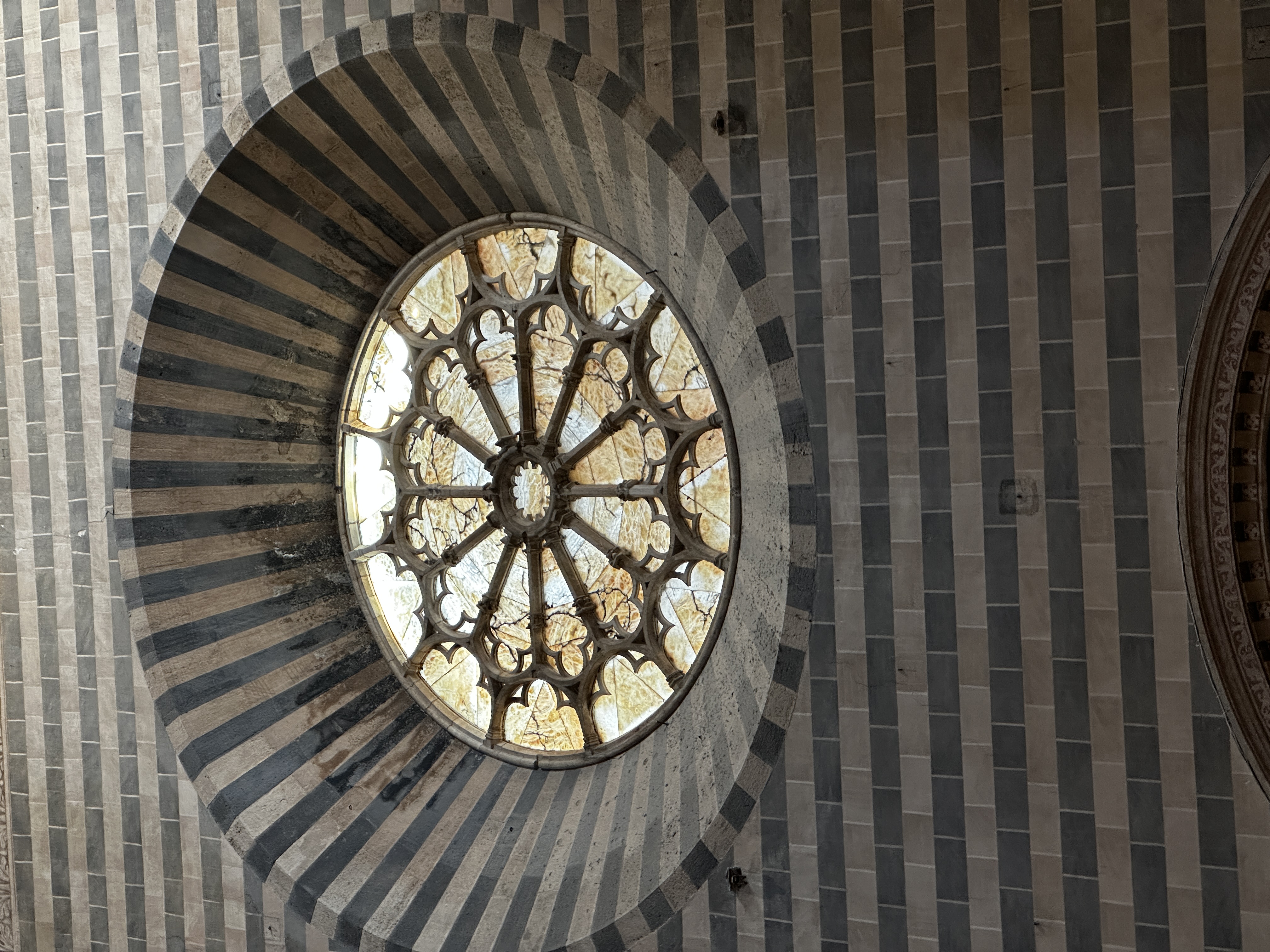
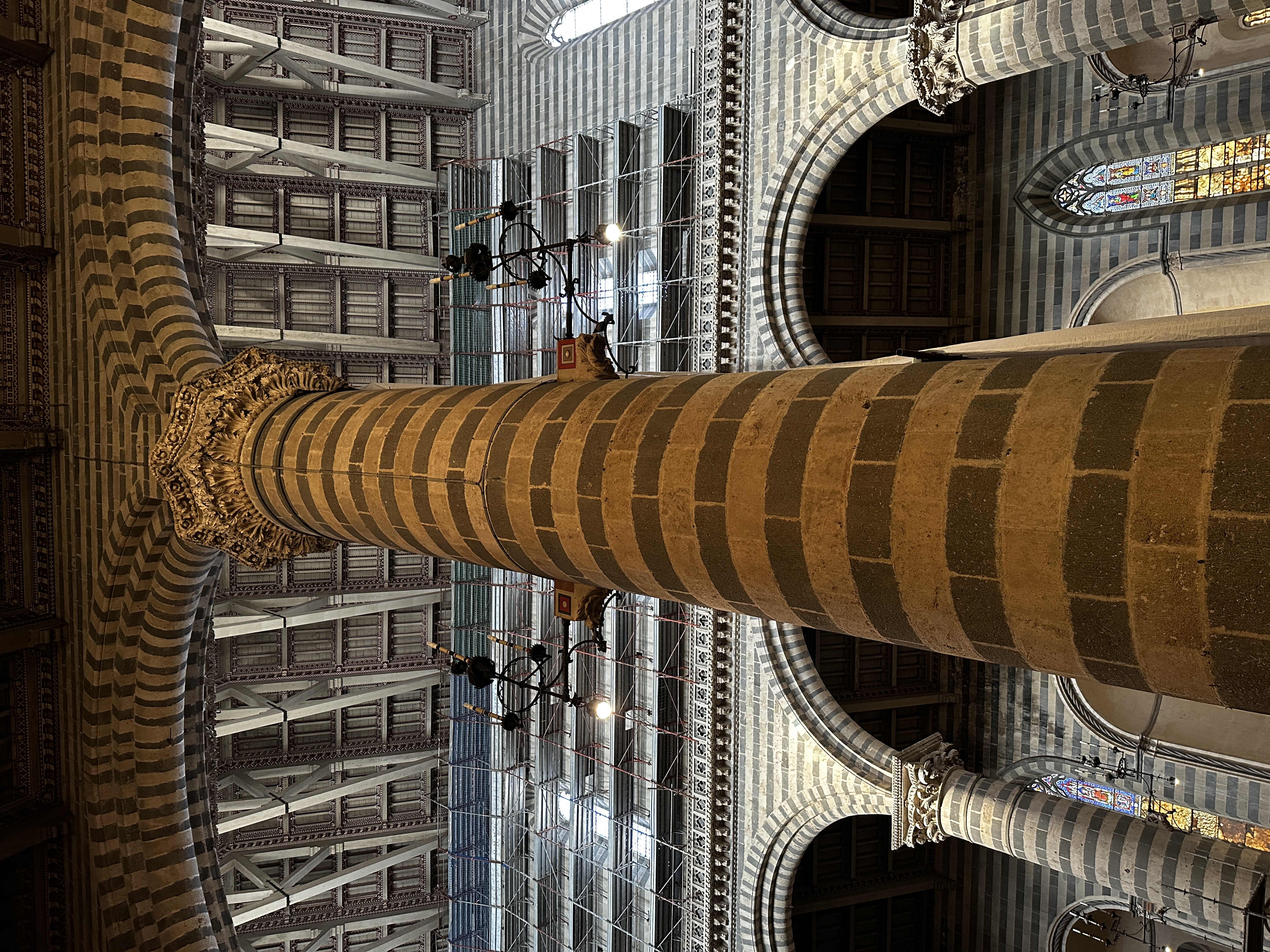
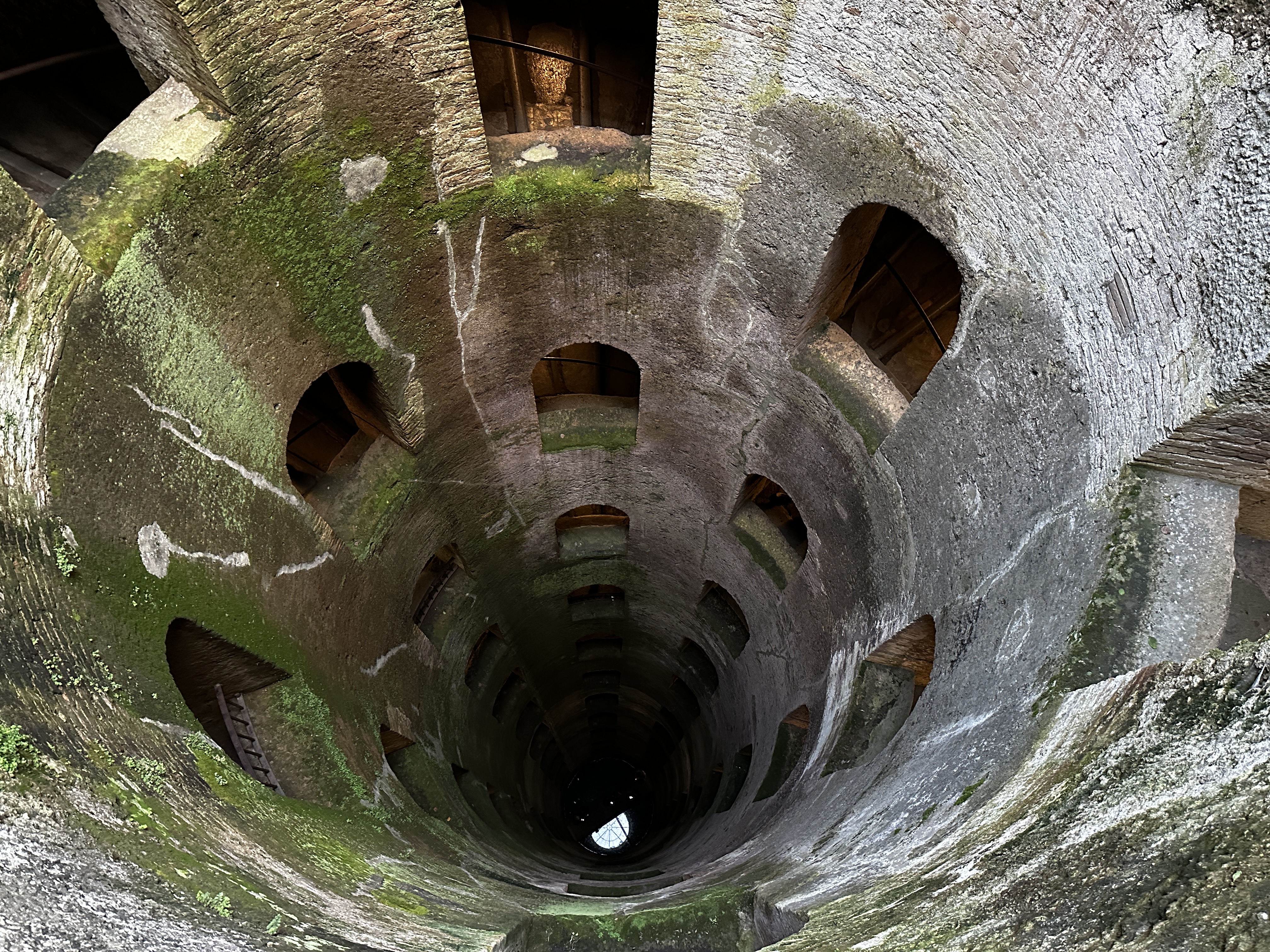
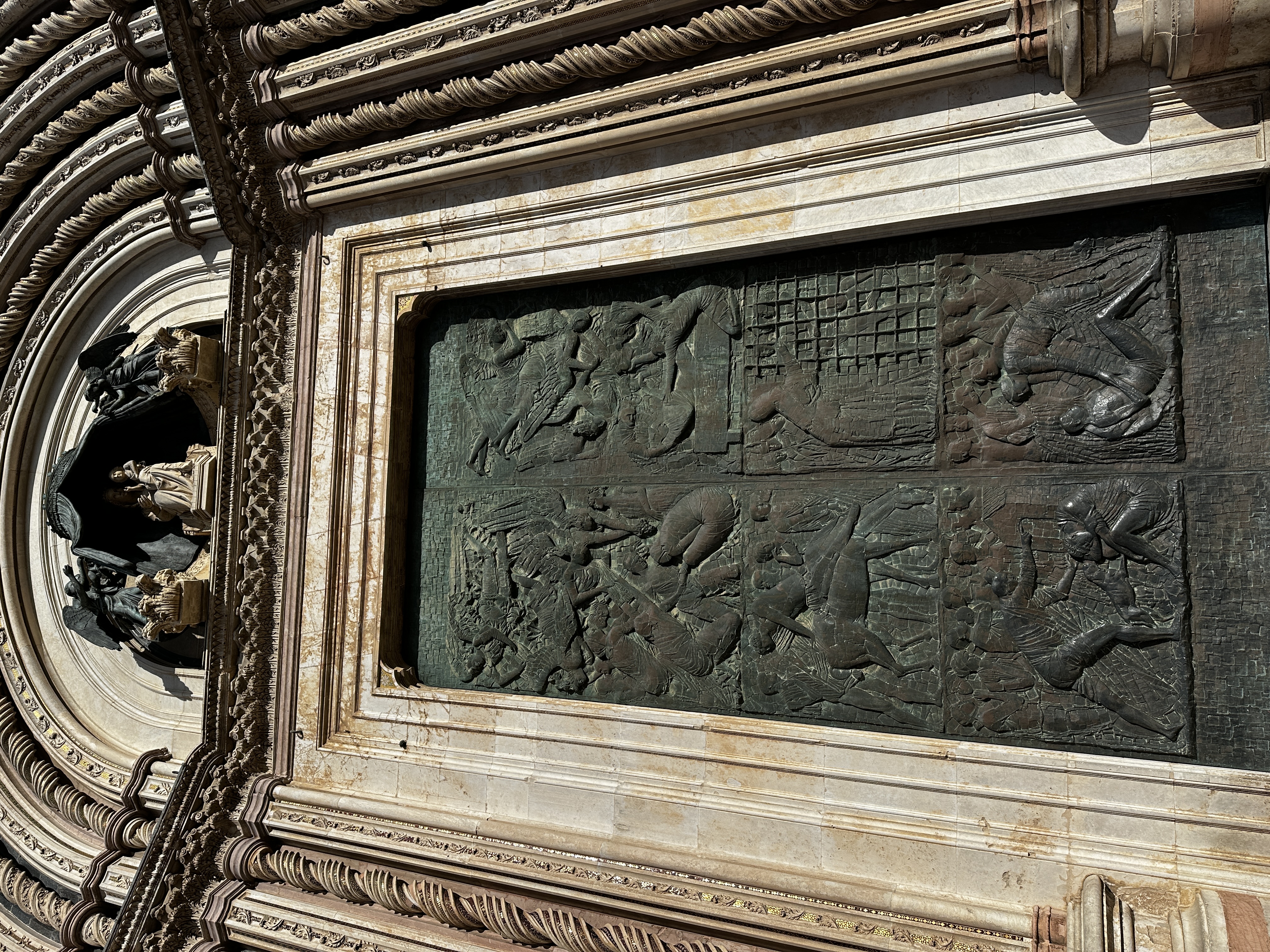
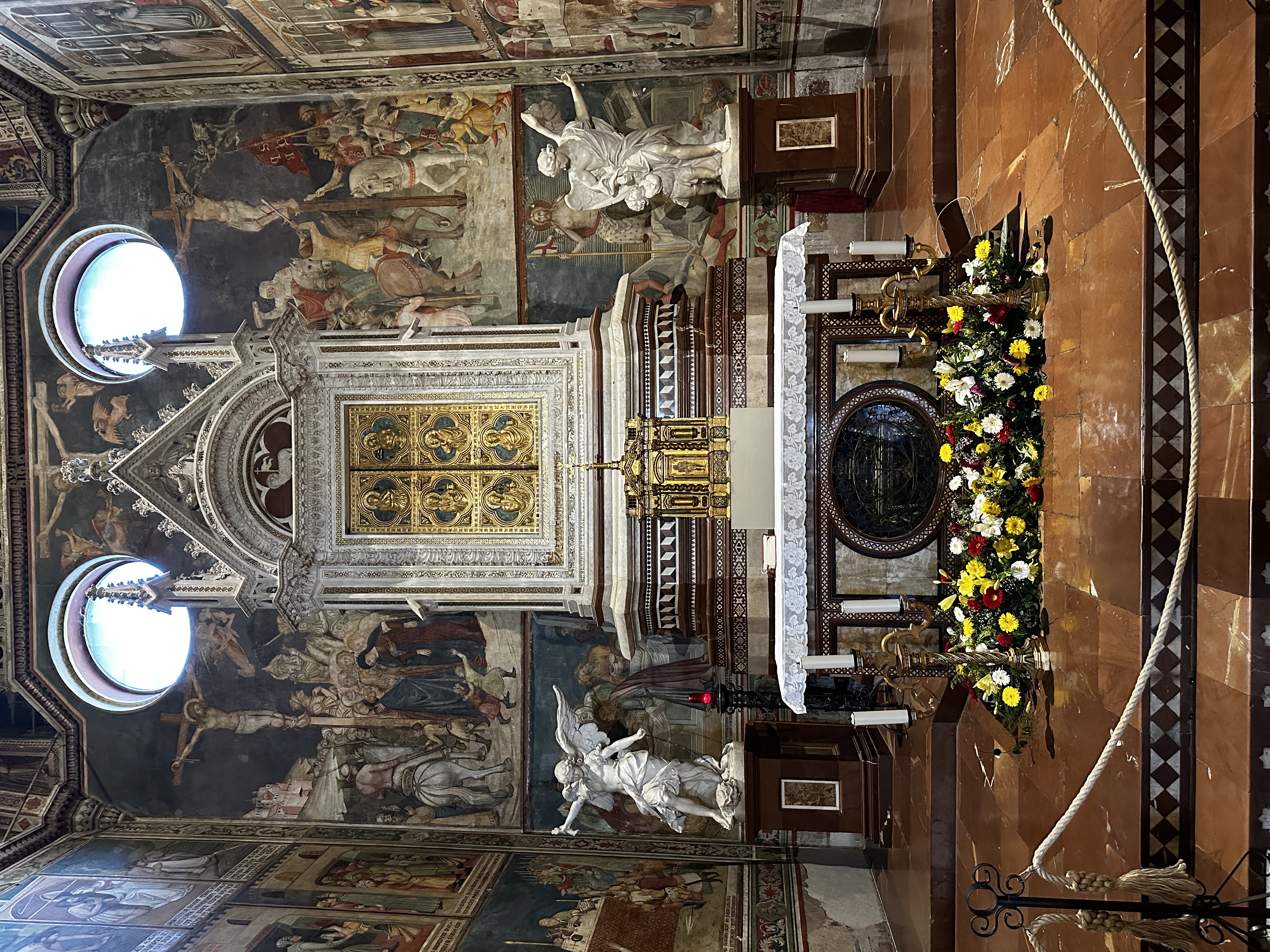
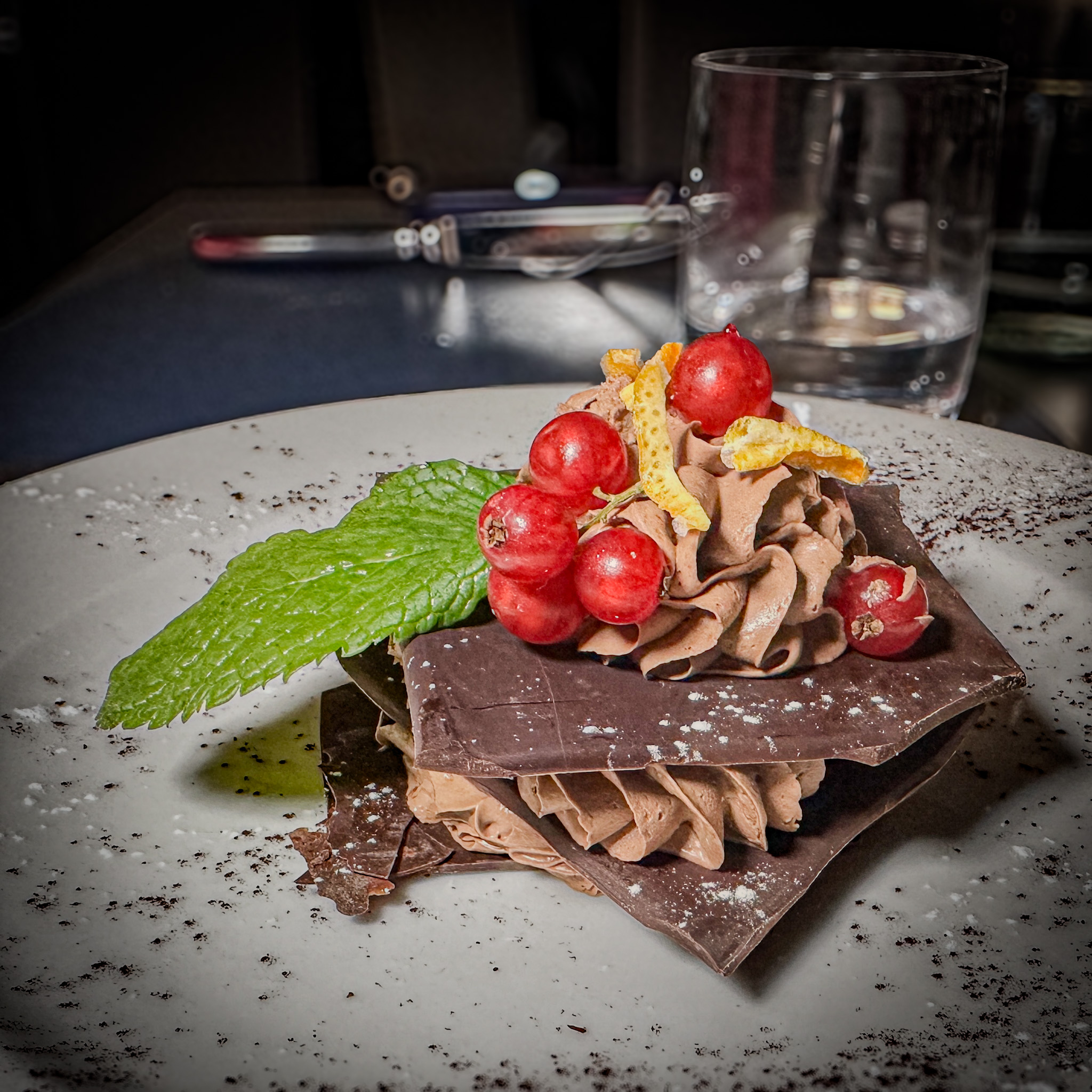
13 November 2024: Orvieto, Umbria—We drove about one-hour-and-a-half outside of Rome (Lazio Region) to a small medieval town, Orvieto (Umbria Region). Orvieto is a charming town that is clustered at the very top of a tall hill, on a flat-surfaced rock that likely resulted from the Bolsena Volcano eruption about 370,000 years ago. The old town of Orvieto is dominated by a piazza that features the Duomo of Orvieto. With its striped patterns both outside and inside, this Duomo is reminiscent of the Duomo of Siena. A beautiful mosaic image adorns the top front face of the edifice. The interior is under renovation, both for purposes of restoration and for protection against possible earthquake damage in the future. There is at least one sculpture of note in this Cathedral, a Chapel of frescos by prominent artists, one of whom, Signorelli, was influential to Michelangelo’s work, and an important relic called the Corporale Eucaristico. The sculpture that struck me is a white marble piece of work called the Pieta. This is a depiction of the taking down of Jesus from the Cross. The expressions on his Mother, Mary, and, I believe, Mary Magdalene, are immensely touching. One can almost see the faces, wet with tears in this phenomenal sculpture. It is said that the artist, Ippolito Scalia, created this masterpiece from one piece of marble. There is a side chapel, the Saint Brazil Chapel, that is renowned for the breathtaking artwork/frescoes, painted by, among some others, Luca Signorelli. This Duomo is also an important place for Catholicism because of another chapel within it, the Chapel of the Sacro Corporale. The Sacro Corporale is a relic that bears the blood stains of a miracle that occurred in Orvieto. When Mass was being celebrated in the 1200s in Orvieto, and at the time of Consecration (when the host is transsubstantiated into the Body of Christ and the wine into His Blood), the Host bled. This is called the Miracle of Bolseno. The Sacro Corporale bears the blood stains on the cloth on which the Host rested. It is exposed for the public on special occasions only, otherwise retained in a marble tabernacle on the altar of the Chapel of the Sacro Corporale. In Orvieto, also, is a UNESCO World Heritage Site called the Pozzo di San Patrizio. This is a deep well built at the behest of Pope Clement VII who had hidden in Orvieto to escape the capture of Rome by Charles V. He was worried about adequate water supply to last a lengthy refuge, thus this well. What is unusual about this well, however, is not only its depth and diameter, but it is also two separate spiral stairways that utilize two separate doors such that a donkey going down to the bottom of the well could also come back up a completely different way. The two stairways never meet. The rest of the old town of Orvieto is composed of charmingly decorated narrow cobblestone streets, lined with restaurants selling regional food and wine and with shops and artisanal products that one can purchase. There, one can find leather purses as well as ceramic products. Dinner was once again at the Hotel Colombo. I had the exact same thing as last night, and John had sirloin steak and a little bit of salad greens. For dessert we shared a Mille feuilles fancy pastry composed off thin sheets off dark chocolate and filled with a chocolate mousse flavored with orange and candied orange rinds. The top of this concoction was decorated with lingonberries and such. Roman food tour tomorrow evening!!!!



 Our Travels