
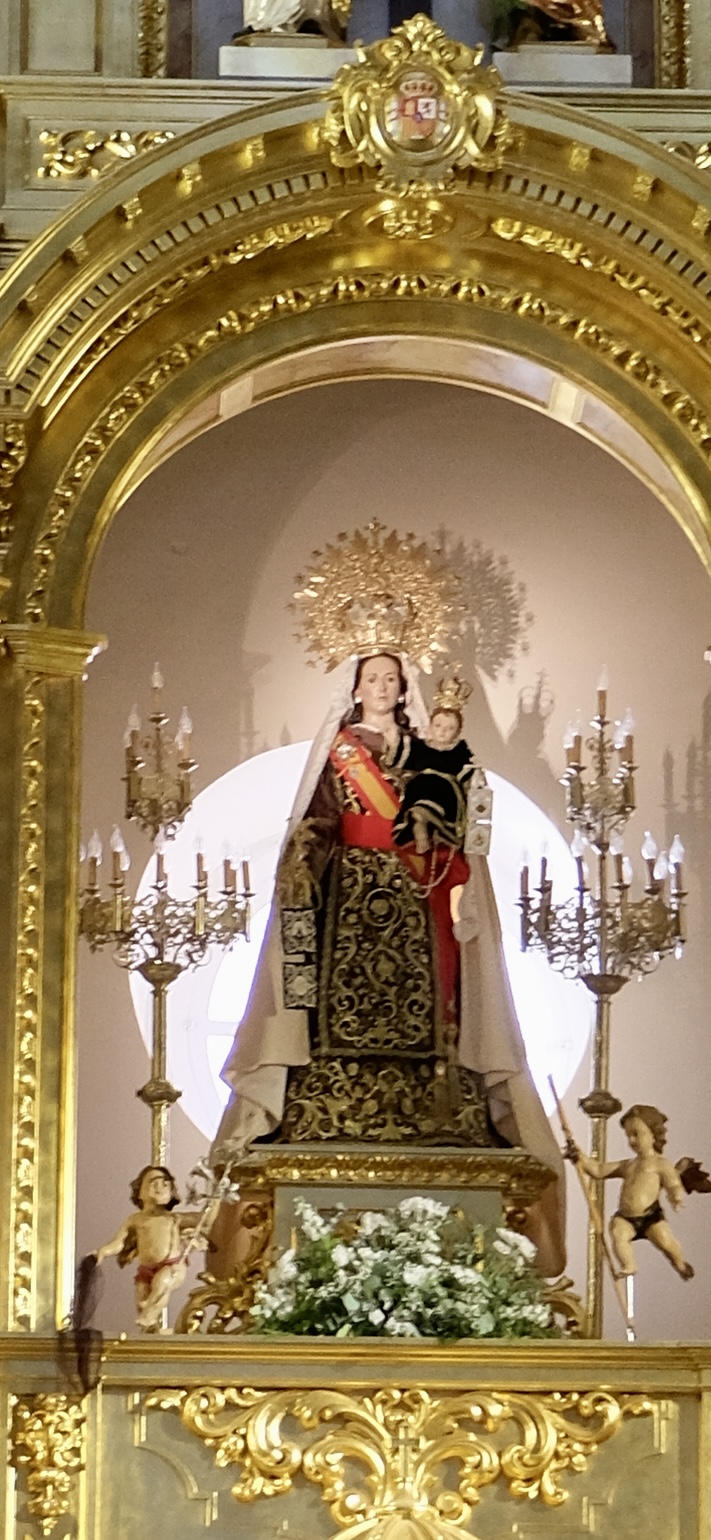
18 November 2024: Cartagena, Spain—This morning we docked in Cartagena, Spain. This is the first of four ports for this transatlantic repositioning cruise. The port revealed a military/naval enterprise, with frigates being towed out of the narrows into the open Sea. There were cranes suggestive of shipbuilding. Other navy-gray ships of different kinds were at port. The town center of Cartagena was in walking distance from where our ship was docked. Thus, John and I ventured off to see what we could see. The town center main streets were paved in marble-like tiles such that when the sun shone on them, they appeared gold and ivory and tan…. And the sun shone the entire day today. It was a perfect weather day for walking and exploring (and for swimming in the on-deck pool onboard, if one wished). The temp was probably in the low 70s Fahrenheit. The wind was mild. It was, indeed, perfect! There were dark metal-looking statues of soldiers carrying their napsacks. The city was preparing for Christmas, with some decorations ready for illumination, and some perhaps not quite yet. The lawn/park-like entry to the town center had lush green grass, with some white sculptures, i.e., a head, what appeared to have been eggs, a woman holding something in her lap, some other abstract-looking creation…. The buildings were large and typically multi-leveled. They also were of different colors, usually pastel. The architecture was grandiose, decorative, and detailed. Verandas in the front of the residences were common. Some of the buildings had been palaces, now converted to some other function, such as, for example, dance classes…. We saw the Navy General’s palace, with four flags in front of it. If one peered into the glass closed door (today is Monday, and it is also a bit off season, so some buildings were closed), one could see some torpedoes inside. One building ended up being the Church of Santo Domingo, with an exterior that looked nothing like other churches we had seen throughout this entire trip, and with an interior that was breathtakingly outstanding! The statues within it are large, dramatic, with vivid colors, and with Mary wearing red and/or black attire. Mary is the Patron of Spain, and she is featured throughout the Church. There is also the Chapel of St. Judas, the Apostle, and another featuring St. Magdalene washing the feet of the deceased Jesus Christ. The expressions of the faces on these statues are so explicit that one could see the tears on Mary’s face as she beheld her crucified Son. One quickly notes that navigation and the sea have been pivotal in the history of Spain because there are statues of Mary and Jesus, with prayers for the safety of seafaring people. The streets were lined with bars, cafes, cafeterias, and restaurants (many were open-air). There were certainly plenty of stores selling souvenirs and a variety of other items, such as jewelry, purses, shoes, socks, clothing….Beautiful palm trees reached unobstructively into the clear blue sky. We stopped at an outside bar and shared three must-haves from Cartagena: a sangria, fresh, crisp churros with chocolate dipping sauce, and Cafe Asiatico. They were delicious! The sangria, because Spain is known for its wine; the churros because it is a favorite finger food/snack item in Spain and because word had spread from ship staff and the cruise activities director that the churros in Cartagena were wonderful (indeed, they were crisp, warm, and they were not sweet at all—-a bag of sugar was served on the side should one wish to top them with the crystals); and the Cafe Asiatico because it is characteristically Cartagenian! Legend has it that in the early 1900s, soldiers returned to Cartagena and asked for cofffee with condensed milk, and it has remained a staple in Cartagenian culture since then. Actually, the Cafe Asiatico is made in a thick drinking glass, layering the condensed milk first (its weight makes it sink to the bottom), cognac, another thinner layer of liqueur, coffee, and a topping of sprinkled cinnamon and lemon or orange peel/rind, some cacao?, and some powdered coffee. Stirred together, the Cafe Asiatico was fantastic! We figured that it was the Spanish version of my father’s “poncino” that he loved so much. We walked back to the ship, reveling in the beautiful scenery we traversed, including mosaic-looking parked vehicle shelters on the dock, trees with different-colored branches/trucks/leaves. Visible on a nearby hilltop was a large brick fortification, so typical for Spain and for Cartagena because the seaport had to be protected through the ages. We also saw evidence of excavations of ancient ruins, but they were kept away from touristsAll in all, Cartagena was a lovely experience from our point of view! The sunset tonight was more difficult to catch because it took place behind one of the mountains at Port. Nevertheless, it was gorgeous as long as we could see it, of COURSE, it was! Tomorrow, we dock at Malaga, Spain, on Spain’s Costa del Sol. We are told that we could walk to town center, although it will be a longer walk than it was for Cartagena. I don’t know if John will go to town to explore with me, but I most certainly will!

 Our Travels